PreparED Study Materials

CHEM 80120: Survey of Chemistry II
School: Clayton State University
Number of Notes and Study Guides Available: 0
Videos
NBS Bromination in CCl4: Light-Induced Chemistry Explained

Want To Learn More? To watch the entire video and ALL of the videos in the series:
full solution
Discover the fascinating world of chemical reactions with N-Bromosuccinimide (NBS) in Carbon Tetrachloride (CCl4), initiated by light. Explore the bromination process and its effects on molecules like cyclopentene, 2,3-dimethylbut-2-ene, and CH3 toluene, leading to valuable insights into organic chemistry.
Molecular Formulas: Lewis Structures for N2, HCN, CO2, C3H6, and More
Want To Learn More? To watch the entire video and ALL of the videos in the series:
full solution
Discover Lewis structures for various molecular formulas, including N2, HCN, CO2, C3H6, and more. Explore their chemical bonding and structural arrangements.
Diluting a 5.5 M KCl Solution to 0.100 M
Want To Learn More? To watch the entire video and ALL of the videos in the series:
full solution
Learn the steps to make a 2.5 L of 0.100 M KCl solution from a 5.5 M stock solution in this easy-to-follow tutorial.
Acid Strength Comparison: Isomers and Proton Removal Explained
Want To Learn More? To watch the entire video and ALL of the videos in the series:
full solution
This video provides insights into determining the acid strength of various isomers by examining the ease of proton removal and the stability of the resulting anion. By comparing Propanamine to Trimethylamine and Methoxyethane to Propanol, we determine which compounds are more acidic.
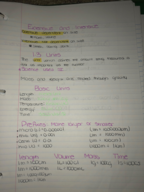
Identifying Fundamental Units in Rb?O, N?, Fe(NO?)?, and N?F?
Want To Learn More? To watch the entire video and ALL of the videos in the series:
full solution
In this exploration, we delve into the fundamental units of various substances, whether they are single atoms, molecules, or formula units. We examine ionic compounds like Rb?O and Fe(NO?)?, characterized by formula units as their basic components, and covalent compounds like N? and N?F?, where molecules are the fundamental units.
Converting Moles to Grams: Aluminum & Chlorine Atomic Mass Breakdown
Want To Learn More? To watch the entire video and ALL of the videos in the series:
full solution
"Explore the intricate world of atomic masses using aluminum and chlorine as examples. Understand the concept of 'mole' and its relevance in chemistry. Learn to calculate masses of moles for elements based on atomic weights.