PreparED Study Materials

CHEM 111: Principles of Chemistry I
School: Pace University
Number of Notes and Study Guides Available: 1
Notes

Videos
Calculate a Building's Age Using Nickel-63 Decay

Want To Learn More? To watch the entire video and ALL of the videos in the series:
full solution
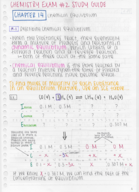
The scenario involves an archaeologist analyzing iron in an old building containing nickel-63, which has a known half-life of 92 years. With only 0.78% of the original nickel-63 remaining, the goal is to estimate the year when this discovery was made. We delve into the calculations and principles of first-order decay reactions.
Volume Calculation for Acetone, Olive Oil, and Chloroform
Want To Learn More? To watch the entire video and ALL of the videos in the series:
full solution
In this video, the presenter demonstrates the process of calculating the volume of 125g for three different liquids—Acetone, Olive oil, and Chloroform—using the formula "Volume = Mass / Density," providing step-by-step solutions for each liquid, ultimately revealing their respective volumes. This instructional video guides viewers through the calculations and showcases the outcome for each liquid's volume.
Molecule Count in 0.334 g of C?H?: Ethane Analysis
Want To Learn More? To watch the entire video and ALL of the videos in the series:
full solution
This instructional video guides you through the process of determining the number of molecules in a given sample. It illustrates the conversion from grams to moles using the molar mass of the substance and then to molecules using Avogadro's number, providing a practical example with ethane (C?H?) to calculate approximately 6.67 x 10²¹ molecules in a 0.334 g sample.
Understanding Average Speed in Kinetic Molecular Theory
Want To Learn More? To watch the entire video and ALL of the videos in the series:
full solution
The kinetic molecular theory of gases describes the random motion and speed distribution of gas molecules in a container, and when considering various statements about the average speeds of these molecules, it's important to understand how they behave under different conditions.
Classify: (a) Mixture (b) Element (c) Mixture (d) Compound
Want To Learn More? To watch the entire video and ALL of the videos in the series:
full solution
In this video, we classify substances as elements, compounds, or mixtures, with air and soy sauce as mixtures, iron as an element, and table salt as a compound.
Identifying Redox Reactions & Agents: Four Chemistry Examples
Want To Learn More? To watch the entire video and ALL of the videos in the series:
full solution
Explore oxidation and reduction processes across four chemical reactions differentiating between acid-base and redox activities. Highlighting key substances and their roles in each reaction.