PreparED Study Materials

CHEM 2400: Organic Chemistry I
School: Georgia State University
Number of Notes and Study Guides Available: 51
Notes
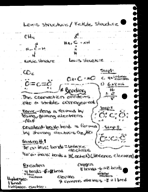











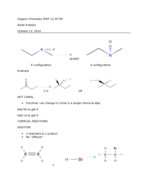


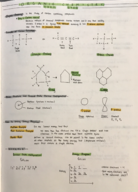
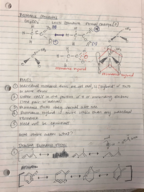
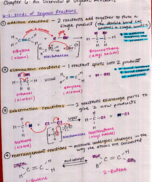

Study Guides







Organic chemistry 1 exam 2 review (Chemistry)
CHEM 2400
Georgia State University
5 pages | Fall 2015

Videos

Want To Learn More? To watch the entire video and ALL of the videos in the series:
full solution
Calculating Percent Composition: Using Molecular Formulas & Atomic Mas
Want To Learn More? To watch the entire video and ALL of the videos in the series:
full solution
Understand the process of calculating percent composition using the molecular formula. Grasp the methodology with compounds like C2H4O2, CH2O2, and more. Discover how atomic masses influence the mass percent of elements in various compounds.
Understanding Microwaves: Boiling Water's Time and Photon Count
Want To Learn More? To watch the entire video and ALL of the videos in the series:
full solution
This video breaks down the process of calculating the time and number of photons required to boil water in a microwave. Using given power, wavelength, and water specifics, we determine both energy needs and photon count.
Determining Oil & Ball Bearing Density: Physics Explained
Want To Learn More? To watch the entire video and ALL of the videos in the series:
full solution
Discover how to determine the density of mineral oil and a metal ball bearing using a graduated cylinder. Learn the method of calculating the mass difference and volume to deduce the density and radius of the ball. Watch a detailed physics experiment explained step by step.
Determining Ionizable H Atoms in Malonic Acid via Neutralization
Want To Learn More? To watch the entire video and ALL of the videos in the series:
full solution
Explore the process of determining ionizable hydrogen atoms in malonic acid using its molecular formula C3H4O4 and a neutralization reaction with Sodium hydroxide. Through methodical calculations involving the given mass of malonic acid and the required volume of Sodium hydroxide for neutralization we uncover that each molecule of malonic acid contains two ionizable H atoms.
Mole Count in Elemental Samples (Zn, Ar, Ta, Li)
Want To Learn More? To watch the entire video and ALL of the videos in the series:
full solution
This video outlines the process of calculating the number of moles in various elemental samples. It begins by explaining the relationship between molar mass and atomic weight. Each sample's mass is divided by the respective element's molar mass to find the number of moles. It provides detailed calculations for four elemental samples: zinc (Zn), argon (Ar), tantalum (Ta), and lithium (Li), converting results to scientific notation where necessary. The script demonstrates how to determine the mole
Textbook Solutions (0)
Top Selling Study Tools


Glycolysis regulation cheat sheet (Chemistry)
CHEM 4600
Georgia State University
3 pages | Fall 2015




Chem 1152k polysaccharide notes (Chemistry)
CHEM 1152
Georgia State University
2 pages | Winter 2016



Chem 1211k (finnegan) test dates (Chemistry)
CHEM 1211
Georgia State University
1 page | Spring 2016