PreparED Study Materials

Videos
Converting Pressure Units to Atmospheres: mmHg, bars, Torr, kPa

Want To Learn More? To watch the entire video and ALL of the videos in the series:
full solution
In this instructional video, we explore the conversion of various pressure units into atmospheres, covering mmHg, bars, Torr, and kPa. The process involves utilizing conversion factors to ensure accurate results for each unit. By the end, you'll have equivalent pressures in atmospheres for the given values, enhancing your understanding of pressure conversions.
Comparing pH: Acid Concentrations Strength Ka pKa & pOH Explained!
Want To Learn More? To watch the entire video and ALL of the videos in the series:
full solution
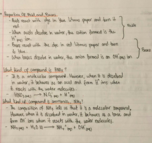
Understanding pH Values: In this video we break down the pH levels of various solutions. Discover the importance of acid strengths via Ka and pKa contrast weak vs. strong acids and learn the counterintuitive relationship between pOH and pH.
Specific Rotation Calculation: Polarimeter Demystified
Want To Learn More? To watch the entire video and ALL of the videos in the series:
full solution
Discover how to calculate specific rotations of samples using a polarimeter in this informative chemistry tutorial. Explore optical activity and learn step-by-step calculations for two real-world examples. Enhance your understanding of specific rotation and its application in chemical analysis.
H-Cl Bond Energy Explained: ?H Signs Formation & Breakage Dynamics
Want To Learn More? To watch the entire video and ALL of the videos in the series:
full solution
Explore the concept of bond energy with the H-Cl bond as a prime example. Delve into the energy dynamics of bond breaking (endothermic positive ?H) versus bond formation (exothermic negative ?H). Understand how the magnitude remains consistent but signs differ based on energy absorption or release.
Homogeneous vs Heterogeneous Mixtures: Examples & Classification Expla
Want To Learn More? To watch the entire video and ALL of the videos in the series:
full solution
Explore the distinction between homogeneous and heterogeneous mixtures. Through real-world examples like baby oil, chocolate chip cookies, and wine, understand their uniformity, phases, and how components are distributed.
Classifying Substances: From Pure Elements to Mixtures Explained
Want To Learn More? To watch the entire video and ALL of the videos in the series:
full solution
Classify substances into various categories: element compound homogeneous mixture and heterogeneous mixture. This video breaks down the fundamental distinctions between pure substances and mixtures illustrating with real-world examples like urine pure water a Snickers™ bar and soil. A concise guide for understanding the essence of material classification in chemistry.