PreparED Study Materials
CHEM 231: Organic Chemistry 1
School: DCH Regional Medical Center
Number of Notes and Study Guides Available: 0
Videos
Classify: (a) Mixture (b) Element (c) Mixture (d) Compound

Want To Learn More? To watch the entire video and ALL of the videos in the series:
full solution
In this video, we classify substances as elements, compounds, or mixtures, with air and soy sauce as mixtures, iron as an element, and table salt as a compound.
Breaking Down Mixtures: Finding Mass Percent of Sodium Compounds
Want To Learn More? To watch the entire video and ALL of the videos in the series:
full solution
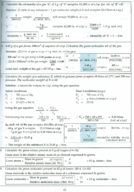
Uncover the method to determine mass percentages of Sodium Bromide and Sodium Sulfate in a mixture using the given Sodium content. Walk through a step-by-step calculation leveraging molar masses to derive the composition. Discover the resulting mass percentages: 23.85% for Sodium Bromide and 76.15% for Sodium Sulfate
Determining Moles of Released Ions in Dissolution Reactions
Want To Learn More? To watch the entire video and ALL of the videos in the series:
full solution
When an ionic compound dissolves in water, it undergoes dissociation into its constituent ions. The total moles of ions released is determined by adding up the moles of each ion generated during this dissociation process. In the case of (a) disodium hydrogen phosphate (Na?HPO?), it dissociates into two sodium ions and one hydrogen phosphate ion. For (b) copper(II) sulfate pentahydrate (CuSO? · 5H?O), it dissociates into one copper ion and one sulfate ion. In (c), nickel(II) chloride (NiCl?) diss
Dilution Calculations: Copper(II) Nitrate, Calcium Chloride, Lithium C
Want To Learn More? To watch the entire video and ALL of the videos in the series:
full solution
Learn how to perform dilution calculations for solutions, including copper(II) nitrate, calcium chloride, and lithium carbonate, to achieve specific concentrations.
Mastering Mass, Moles, Formula Units & Atoms
Want To Learn More? To watch the entire video and ALL of the videos in the series:
full solution
Discover how to precisely calculate mass, moles, formula units, and atoms in various compounds. Understand the concept with examples like chromium(III) sulfate decahydrate, dichlorine heptoxide, and lithium sulfate. Master chemistry calculations through a step-by-step guide.
Orthorhombic Unit Cell: Decoding Nickel Sulfate's Crystal Density
Want To Learn More? To watch the entire video and ALL of the videos in the series:
full solution
The video offers an insightful look into the orthorhombic unit cell, a unique crystal lattice structure. By exploring nickel sulfate's unit cell and its specific dimensions, we determine both the number of formula units and the density of this crystalline structure.