PreparED Study Materials

CHE 163: General Chemistry 1
School: Illinois State University
Number of Notes and Study Guides Available: 1
Notes

Videos
Pseudo-Noble Gas Configurations: A Unique Path to Atomic Stability

Want To Learn More? To watch the entire video and ALL of the videos in the series:
full solution
Discover the concept of the pseudo-noble gas configuration, differentiating it from the traditional noble gas configuration. Examine examples like tin and indium to illustrate how elements achieve this unique state of stability. Unpack the intriguing intricacies within atomic structures.
Evolutionary Implications of Cytochromes vs. Hemoglobin and Myoglobin
Want To Learn More? To watch the entire video and ALL of the videos in the series:
full solution
In this video, we delve into the fascinating world of evolutionary adaptations in heme-containing proteins.
Constitution of Compounds: CH4O, CH3Cl, C2H6, CH5N, C2F6, C2H5Br, C3H8
Want To Learn More? To watch the entire video and ALL of the videos in the series:
full solution
Unraveling Molecular Structures: Explore the composition of compounds with molecular formulas CH4O, CH3Cl, C2H6, CH5N, C2F6, C2H5Br, and C3H8. Learn about their unique structures and properties.
Chromium & Oxygen: Limiting Reactants & Chromium(III) Oxide Formation
Want To Learn More? To watch the entire video and ALL of the videos in the series:
full solution
Unravel the reaction of chromium and oxygen forming chromium(III) oxide. Examine different scenarios to determine the limiting reactant using stoichiometric ratios. Understand how to predict product amounts through these calculations.
Ethylene Glycol & Freezing Point in Antifreeze
Want To Learn More? To watch the entire video and ALL of the videos in the series:
full solution
We explore the impact of increasing the concentration of ethylene glycol in an antifreeze mixture, explaining the resulting effect on the freezing point of the solution by examining its interaction with water molecules.
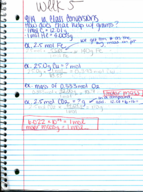
Calculate oxygen molar concentration in water at 25°C with a partial p
Want To Learn More? To watch the entire video and ALL of the videos in the series:
full solution
This video explores molar concentration (molarity) and demonstrates the calculation of oxygen's molar concentration in water at 25°C, considering a partial pressure of 0.22 atm by employing Henry's Law and the given Henry's Law constant for oxygen, revealing that under these conditions, there are 2.86 x 10?? moles of oxygen per liter of water, highlighting the significance of understanding these concepts for managing gas dissolution in liquids across varying circumstances.
Textbook Solutions (0)
Top Selling Study Tools





Che140 lecture notes 10.5 - 10.9 (Chemistry)
CHE 140
Illinois State University
5 pages | Summer 2015