PreparED Study Materials

CHE 310: Information Systems Analysis
School: Illinois State University
Number of Notes and Study Guides Available: 0
Videos
Density Explained: Calculating the Density of an Osmium Cube

Want To Learn More? To watch the entire video and ALL of the videos in the series:
full solution
In this tutorial, we break down the principle of density, illustrating it as a measure of mass per unit volume. Using an osmium cube as a practical example, we walk viewers through the steps of computing its density, demonstrating the interplay between mass, volume, and particle arrangement.
Element Classification: Rep, Trans, Inner-Trans, Noble Gases
Want To Learn More? To watch the entire video and ALL of the videos in the series:
full solution
We categorize elements into representative, transition, inner-transition, and noble gases based on their positions in the periodic table and general characteristics, without revealing specific element classifications.
Structures & Classifications of C?H?? Alkyl Groups: From Primary to Te
Want To Learn More? To watch the entire video and ALL of the videos in the series:
full solution
Explore the diverse structures of C?H?? alkyl groups and classify them into primary, secondary, or tertiary categories. Through a visualization of carbon atom arrangements, uncover the nuances of n-pentyl, sec-pentyl, tert-pentyl, isopentyl, and neopentyl structures.
pAg in KI & AgNO3 Titration: Exploring 39mL & 44.30mL Volumes
Want To Learn More? To watch the entire video and ALL of the videos in the series:
full solution
Exploring the titration of 25.00 mL of 0.08230 M KI with 0.05110 M AgNO3. This video breaks down the calculation process for the potential of silver ion at various volumes of added AgNO3: 39.00 mL equivalence point and 44.30 mL. With clear steps and using the solubility product constant understand how the potential of silver ion is determined for each scenario.
Want To Learn More? To watch the entire video and ALL of the videos in the series:
full solution
Molar Mass Calculation: Sr(OH)2 N2O3 NaClO3 Cr2O3 Explained!
Want To Learn More? To watch the entire video and ALL of the videos in the series:
full solution
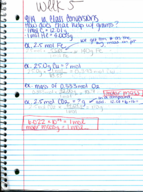
In this chemistry tutorial learn how to calculate the molar mass of various compounds using atomic masses from the periodic table. Discover the molar mass for compounds such as Strontium Hydroxide Dinitrogen Trioxide Sodium Chlorate and Chromium(III) Oxide. A concise guide to understanding molar masses and their real-world applications.
Textbook Solutions (0)
Top Selling Study Tools




Che140 lecture notes 10.5 - 10.9 (Chemistry)
CHE 140
Illinois State University
5 pages | Summer 2015