PreparED Study Materials

PHYS 116: Mathematical Methods for Physics
School: University of California - Santa Cruz
Number of Notes and Study Guides Available: 12
Notes





Study Guides

Videos
Projectile Range and Optimal Launch Angles Explained

Want To Learn More? To watch the entire video and ALL of the videos in the series:
full solution
Join us in this enlightening video as we explore the fascinating world of projectiles and their optimal launch angles. We dive into the physics behind how a fixed initial speed affects the range of a projectile and why, for most angles, there are two choices that yield the same range. Delve into factors that affect an archer's ability to hit a target, including wind, and learn why a smaller angle, closer to the horizontal, is often preferable. Discover when and why a larger angle may be necessar
Want To Learn More? To watch the entire video and ALL of the videos in the series:
full solution
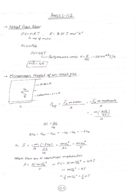
Jet Takeoff: Tire Rotation, Centripetal Acceleration, and Bacterium's
Want To Learn More? To watch the entire video and ALL of the videos in the series:
full solution
Discover the dynamics of a commercial jet takeoff in this video! We explore tire rotation speed, centripetal acceleration, and a bacterium's grip on the rim. Dive into physics and microscopic forces, all while considering weight ratios.
Earth's Measurements: Circumference, Surface Area, and Volume
Want To Learn More? To watch the entire video and ALL of the videos in the series:
full solution
Explore Earth's dimensions in this video! We calculate its circumference, surface area, and volume. Join us to understand the scope of our planet, both in its physical size and mathematical concepts.
Kinetic Energy: Saturn 5 & Apollo at 11.2 km/s Speed
Want To Learn More? To watch the entire video and ALL of the videos in the series:
full solution
Learn how to calculate the kinetic energy of a Saturn 5 rocket with an Apollo spacecraft attached using physics principles and formulas. Understand the importance of unit conversion and the work-energy theorem as you plug values into the KE = 1/2 mv² formula. Discover that the kinetic energy for this rocket and spacecraft combo is an astonishing 1.82 x 10¹³ Joules.
Warm Hands by Friction: Temperature Increase Calculation
Want To Learn More? To watch the entire video and ALL of the videos in the series:
full solution
Join us to explore the science of hand-warming through friction in this video. We calculate the temperature increase as a woman rubs her hands together, converting work into thermal energy. Dive into the physics of heat generation and discover how friction can keep you warm.