PreparED Study Materials

CHB 1134: General Chemistry 2 Lab
School: University of Colorado at Boulder
Number of Notes and Study Guides Available: 0
Videos
Evolutionary Implications of Cytochromes vs. Hemoglobin and Myoglobin

Want To Learn More? To watch the entire video and ALL of the videos in the series:
full solution
In this video, we delve into the fascinating world of evolutionary adaptations in heme-containing proteins.
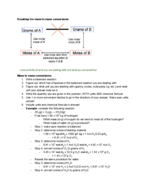
Calculating the Amount of Cesium and Iodine in a 38.77g Cs-I Compound
Want To Learn More? To watch the entire video and ALL of the videos in the series:
full solution
Learn how to calculate the amounts of Cesium and Iodine in a 38.77g sample of a Cs-I compound. Starting with a 125g compound this tutorial uses conversion factors to find 19.83g of Cesium and 18.94g of Iodine. Perfect for chemistry students seeking to master stoichiometry and compound analysis.
Amino Acid Structural Formulas at Low pH
Want To Learn More? To watch the entire video and ALL of the videos in the series:
full solution
Explore the protonation of amino acids, specifically valine and threonine, when subjected to a pH lower than their isoelectric points, highlighting the structural changes in their carboxyl and amino groups.
Do Rusting and Burning Violate Conservation of Mass?
Want To Learn More? To watch the entire video and ALL of the videos in the series:
full solution
This video explores the processes of rusting in iron and burning a match, addressing whether the observed changes in mass violate the law of conservation of mass, and explains how these processes align with the law.
Mole Count in Elemental Samples (Zn, Ar, Ta, Li)
Want To Learn More? To watch the entire video and ALL of the videos in the series:
full solution
This video outlines the process of calculating the number of moles in various elemental samples. It begins by explaining the relationship between molar mass and atomic weight. Each sample's mass is divided by the respective element's molar mass to find the number of moles. It provides detailed calculations for four elemental samples: zinc (Zn), argon (Ar), tantalum (Ta), and lithium (Li), converting results to scientific notation where necessary. The script demonstrates how to determine the mole
What makes bubbles when water boils?
Want To Learn More? To watch the entire video and ALL of the videos in the series:
full solution
When water boils, bubbles rise to the surface, but what's in these bubbles? Let's evaluate the options. Option d, water vapor, is correct; the bubbles during boiling are primarily composed of water vapor, the gaseous state of water.