PreparED Study Materials

CH 223: Organic Chemistry 2
School: North Carolina State University
Number of Notes and Study Guides Available: 13
Notes

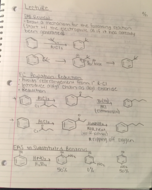

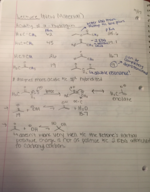
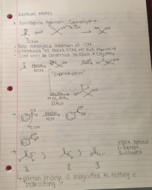



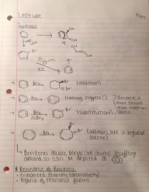
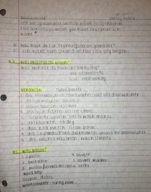
Ch 223 week 1 notes continued (Chemistry)
CH 223
North Carolina State University
2 pages | Fall 2016
Study Guides


Videos
Precipitation Reactions Explained: From Solution to Solid Formation

Want To Learn More? To watch the entire video and ALL of the videos in the series:
full solution
Unravel the chemistry behind precipitation reactions and the creation of insoluble salts. Learn how aqueous ions interact to form solid precipitates, illustrated with examples like silver nitrate and sodium chloride. Understand their significance in fields from water treatment to qualitative analysis.
Calculating the Amount of Cesium and Iodine in a 38.77g Cs-I Compound
Want To Learn More? To watch the entire video and ALL of the videos in the series:
full solution
Learn how to calculate the amounts of Cesium and Iodine in a 38.77g sample of a Cs-I compound. Starting with a 125g compound this tutorial uses conversion factors to find 19.83g of Cesium and 18.94g of Iodine. Perfect for chemistry students seeking to master stoichiometry and compound analysis.
Molecule Count in 0.334 g of C?H?: Ethane Analysis
Want To Learn More? To watch the entire video and ALL of the videos in the series:
full solution
This instructional video guides you through the process of determining the number of molecules in a given sample. It illustrates the conversion from grams to moles using the molar mass of the substance and then to molecules using Avogadro's number, providing a practical example with ethane (C?H?) to calculate approximately 6.67 x 10²¹ molecules in a 0.334 g sample.
Lattice Energy: Always Positive; Hydration Energy: Always Negative
Want To Learn More? To watch the entire video and ALL of the videos in the series:
full solution
In this video we clarify why lattice energy in solids is always a positive value due to the energy needed to separate ions making it an endothermic process. On the flip side hydration energy is always negative as it releases heat when ions dissolve in water making it an exothermic reaction. We use sodium chloride as a real-world example to illustrate these crucial thermodynamic concepts
Volume of 49.8g HCl Gas at STP: Finding the Answer in Liters
Want To Learn More? To watch the entire video and ALL of the videos in the series:
full solution
This video guides viewers through the process of calculating the volume occupied by Hydrochloric acid gas or HCl at standard temperature and pressure. Using the molar mass of HCl and its properties as an ideal gas the tutorial comprehensively explains each step to determine the volume from a given mass at STP. A must-watch for understanding gas volume conversions in chemistry
Homogeneous vs Heterogeneous Mixtures: Examples & Classification Expla
Want To Learn More? To watch the entire video and ALL of the videos in the series:
full solution
Explore the distinction between homogeneous and heterogeneous mixtures. Through real-world examples like baby oil, chocolate chip cookies, and wine, understand their uniformity, phases, and how components are distributed.