PreparED Study Materials

PHY 101: Objects in Motion
School: Kent State University
Number of Notes and Study Guides Available: 1
Notes

Videos
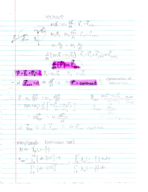
Triangle Masses: Net Force and Side Length Effects

Want To Learn More? To watch the entire video and ALL of the videos in the series:
full solution
Discover the gravitational forces at play in a triangle of masses in this video. We calculate the net force on each mass and explore how changing the side length impacts these forces. Join us for a gravitational journey through physics.
Want To Learn More? To watch the entire video and ALL of the videos in the series:
full solution
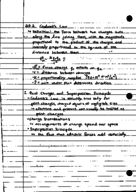
Flashlight Bulb Power and Battery Terminal Voltage
Want To Learn More? To watch the entire video and ALL of the videos in the series:
full solution
Illuminate the science of flashlight power! In this video, we explore how a 6V bulb is powered by a 3V battery with an internal resistance. We calculate the power dissipation of the bulb and the terminal voltage of the battery, unraveling the physics of electrical circuits.
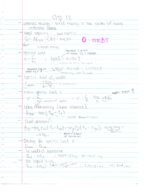
Comparing Single-Pane and Double-Pane Heat Loss Ratios
Want To Learn More? To watch the entire video and ALL of the videos in the series:
full solution
Explore the world of thermal insulation and heat loss in this video. We compare single-pane and double-pane windows, calculating the heat loss ratio. Delve into the fascinating science of heat transfer and insulation factors. Join us to uncover the secrets behind energy-efficient windows.
Maximum Speed of a Whirling Ball with a Breaking String
Want To Learn More? To watch the entire video and ALL of the videos in the series:
full solution
Discover the limits of circular motion as we explore the maximum speed a ball can achieve before its string breaks. Uncover the physics behind this thrilling scenario in our engaging video.
Particle Count, Charge, and Mass of Electron-Proton System
Want To Learn More? To watch the entire video and ALL of the videos in the series:
full solution
oin us as we delve into the intriguing world of subatomic particles! In this video, we'll decipher the composition of a system containing 1525 electrons and protons with a net charge of -5.456 x 10^-17 C. Discover the precise number of electrons and calculate the total mass of this dynamic system. Unlock the secrets of particle physics with us!