PreparED Study Materials
CHEM 120: Organic Chemistry Principles (Lecture)
School: Seton Hill University
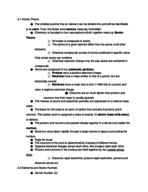
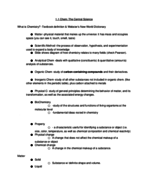
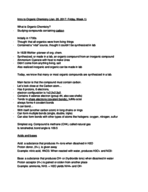
Number of Notes and Study Guides Available: 2
Notes

Videos
Why Fluorine Can't Form FH? or FCl?: Unpacking VSEPR Theory & Electron

Want To Learn More? To watch the entire video and ALL of the videos in the series:
full solution
Explore why fluorine, with its seven valence electrons, doesn't form compounds like FH? or FCl?. Understand the role of VSEPR theory, atomic size, and electronegativity in limiting bond formation. Grasp the interplay of geometric challenges and electron repulsion in compound stability.
Volume of 49.8g HCl Gas at STP: Finding the Answer in Liters
Want To Learn More? To watch the entire video and ALL of the videos in the series:
full solution
This video guides viewers through the process of calculating the volume occupied by Hydrochloric acid gas or HCl at standard temperature and pressure. Using the molar mass of HCl and its properties as an ideal gas the tutorial comprehensively explains each step to determine the volume from a given mass at STP. A must-watch for understanding gas volume conversions in chemistry
Molecular Lewis Structures for CH?, CO?, H?Se, and NH?
Want To Learn More? To watch the entire video and ALL of the videos in the series:
full solution
In this video, we demonstrate the creation of Lewis structures for methane, carbon dioxide, hydrogen selenide, and ammonia, highlighting the arrangement of atoms and bonds in each molecule. The video emphasizes the importance of Lewis structures in visualizing atomic bonding and the presence of lone electron pairs.
Molarity Calculations for Various Solutions: CH?OH, CaCl?, C??H?
Want To Learn More? To watch the entire video and ALL of the videos in the series:
full solution
Learn how to calculate the molarity of different solutions containing methanol, calcium chloride, and naphthalene. Essential for chemistry enthusiasts.
Identifying Redox Reactions & Agents: Four Chemistry Examples
Want To Learn More? To watch the entire video and ALL of the videos in the series:
full solution
Explore oxidation and reduction processes across four chemical reactions differentiating between acid-base and redox activities. Highlighting key substances and their roles in each reaction.
Vaporization vs. Condensation: Heat Dynamics in Phase Transitions
Want To Learn More? To watch the entire video and ALL of the videos in the series:
full solution
Unravel the science behind endothermic and exothermic processes by studying vaporization and condensation. Grasp the molecular changes involved and understand the role of heat in these transformations. A comprehensive look into why vaporization requires heat, while condensation releases it.