PreparED Study Materials

CHEM 113: General Chemistry II
School: Colorado State University
Number of Notes and Study Guides Available: 0
Videos
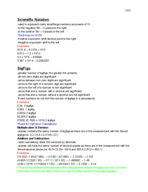
Unraveling Hydrocarbon Structures: Decoding Degrees of Unsaturation

Want To Learn More? To watch the entire video and ALL of the videos in the series:
full solution
Explore the concept of the degree of unsaturation in hydrocarbons. Understand its importance in revealing double bonds, triple bonds, or rings. Learn through examples like limonene, squalene, and lycopene.
Theoretical Yield of TiCl? for Various Reactant Quantities
Want To Learn More? To watch the entire video and ALL of the videos in the series:
full solution
Explore how to calculate the theoretical yield of TiCl? in moles based on different initial quantities of reactants in the chemical equation Ti + 2 Cl? ? TiCl?.
Molecular Geometry & Polarity: Why CO? & CCl? Are Nonpolar Explained
Want To Learn More? To watch the entire video and ALL of the videos in the series:
full solution
Uncover the intriguing relationship between molecular geometry and polarity in chemistry. Using CO? and CCl? as examples, learn how polar bonds can result in nonpolar molecules. Recognize the role of symmetry in determining molecular polarity.
Comparing Bond Types: Ethane's Nonpolarity vs. Fluoromethane's Ionic L
Want To Learn More? To watch the entire video and ALL of the videos in the series:
full solution
Examine the nature of bonds in methylamine, ethane, fluoromethane, and methanol. Identify ethane's nonpolar covalent bond and understand why fluoromethane's bond leans toward the ionic spectrum. Grasp essential concepts in molecular bonding with this deep analysis.
Quantifying Atoms Molecules & Moles: A Comprehensive Chemistry Guide
Want To Learn More? To watch the entire video and ALL of the videos in the series:
full solution
Grasp the fundamental concept of moles in chemistry by equating it to the universally understood notion of a dozen. This video breaks down the usage of Avogadro's constant demonstrating calculations from moles to particles and vice versa. Using real-world examples like Carbon atoms Sulfur Dioxide molecules and Iron atoms viewers gain a clear understanding of moles and particle conversions
1828 Synthesis of Urea: Pioneering Steps in Biochemistry
Want To Learn More? To watch the entire video and ALL of the videos in the series:
full solution
Explore the groundbreaking moment in 1828 when Wöhler synthesized urea, the first organic compound. Join us in this video as we trace the profound impact of this achievement on the field of biochemistry and its significance in unraveling the mysteries of life's complex chemistry.