PreparED Study Materials

CHE 315: Instrumental Analysis
School: Illinois State University
Number of Notes and Study Guides Available: 0
Videos
Orthorhombic Unit Cell: Decoding Nickel Sulfate's Crystal Density

Want To Learn More? To watch the entire video and ALL of the videos in the series:
full solution
The video offers an insightful look into the orthorhombic unit cell, a unique crystal lattice structure. By exploring nickel sulfate's unit cell and its specific dimensions, we determine both the number of formula units and the density of this crystalline structure.
Calculating Formula Masses: From Barium Bromide to Hydrobromic Acid
Want To Learn More? To watch the entire video and ALL of the videos in the series:
full solution
Understand the process of calculating formula masses for various compounds. This video breaks down the atomic masses for elements in barium bromide, dinitrogen trioxide, copper(I) sulfate, and hydrobromic acid. Master the method of summing up the masses considering atom count in each formula.
Identifying Elements, Compounds, and Mixtures
Want To Learn More? To watch the entire video and ALL of the videos in the series:
full solution
Join us in this enlightening video where we unravel the world of chemistry. We'll examine a series of options to identify elements, compounds, and mixtures. Explore the fascinating world of matter and discover how to distinguish these fundamental concepts. Whether you're a student or simply curious about the world of chemistry, this video will help you sharpen your understanding of the building blocks of matter.
Positron Emission Nuclear Equations: Co-55, Na-22, F-18
Want To Learn More? To watch the entire video and ALL of the videos in the series:
full solution
Learn how to write nuclear equations for positron emission with Co-55, Na-22, and F-18. Explore the fascinating world of nuclear reactions.
Converting Moles to Grams: Aluminum & Chlorine Atomic Mass Breakdown
Want To Learn More? To watch the entire video and ALL of the videos in the series:
full solution
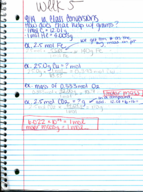
"Explore the intricate world of atomic masses using aluminum and chlorine as examples. Understand the concept of 'mole' and its relevance in chemistry. Learn to calculate masses of moles for elements based on atomic weights.
Mastering Ionic and Net Ionic Equations for Varied Chemical Reactions
Want To Learn More? To watch the entire video and ALL of the videos in the series:
full solution
Discover the art of writing balanced, complete ionic, and net ionic equations for various chemical reactions. Learn the nuances that differentiate between these equations and watch them applied to diverse chemical reactants.
Textbook Solutions (0)
Top Selling Study Tools





Che140 lecture notes 10.5 - 10.9 (Chemistry)
CHE 140
Illinois State University
5 pages | Summer 2015