PreparED Study Materials

CHEM 1015: Introduction to Chemistry
School: University of Minnesota
Number of Notes and Study Guides Available: 7
Notes
Study Guides


Videos
Specific Rotation Calculation: Polarimeter Demystified

Want To Learn More? To watch the entire video and ALL of the videos in the series:
full solution
Discover how to calculate specific rotations of samples using a polarimeter in this informative chemistry tutorial. Explore optical activity and learn step-by-step calculations for two real-world examples. Enhance your understanding of specific rotation and its application in chemical analysis.
Lattice Energy: Always Positive; Hydration Energy: Always Negative
Want To Learn More? To watch the entire video and ALL of the videos in the series:
full solution
In this video we clarify why lattice energy in solids is always a positive value due to the energy needed to separate ions making it an endothermic process. On the flip side hydration energy is always negative as it releases heat when ions dissolve in water making it an exothermic reaction. We use sodium chloride as a real-world example to illustrate these crucial thermodynamic concepts
Mole Count in Elemental Samples (Zn, Ar, Ta, Li)
Want To Learn More? To watch the entire video and ALL of the videos in the series:
full solution
This video outlines the process of calculating the number of moles in various elemental samples. It begins by explaining the relationship between molar mass and atomic weight. Each sample's mass is divided by the respective element's molar mass to find the number of moles. It provides detailed calculations for four elemental samples: zinc (Zn), argon (Ar), tantalum (Ta), and lithium (Li), converting results to scientific notation where necessary. The script demonstrates how to determine the mole
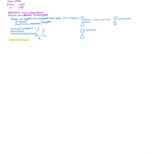
Glucose Polymer with Alternating Glycosidic Linkages: Structure and Fu
Want To Learn More? To watch the entire video and ALL of the videos in the series:
full solution
Explore the fascinating discovery of a glucose polymer with alternating glycosidic linkages. We'll visualize its Haworth projection and investigate its potential role in organisms, pondering whether it primarily serves a structural or energy storage function. Additionally, we'll discuss which types of organisms might utilize this unique polysaccharide as a potential food source.
Ethylene Glycol & Freezing Point in Antifreeze
Want To Learn More? To watch the entire video and ALL of the videos in the series:
full solution
We explore the impact of increasing the concentration of ethylene glycol in an antifreeze mixture, explaining the resulting effect on the freezing point of the solution by examining its interaction with water molecules.
Comparing Masses: Analyzing Water, Ethanol, Chloroform & Balsa Wood
Want To Learn More? To watch the entire video and ALL of the videos in the series:
full solution
Explore the relationship between mass, density, and volume using real-life examples, including water, ethanol, chloroform, and balsa wood. Learn the process of calculating mass and uncover which substance has the highest mass based on given conditions.