PreparED Study Materials

CHEM,PHYS 112: General Chemistry II
School: Coastal Carolina University
Number of Notes and Study Guides Available: 7
Notes



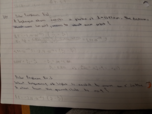

Chemistry 112 week 4 notes (Chemistry)
CHEM,PHYS 112
Coastal Carolina University
5 pages | Fall 2015

Videos
Pure Substances vs. Mixtures: Classifying Based on Composition & Distr

Want To Learn More? To watch the entire video and ALL of the videos in the series:
full solution
Understand the fundamental distinctions between pure substances and mixtures. Unpack the definitions and real-world examples of elements, compounds, homogeneous, and heterogeneous mixtures.
Molar Mass Calculation: Sr(OH)2 N2O3 NaClO3 Cr2O3 Explained!
Want To Learn More? To watch the entire video and ALL of the videos in the series:
full solution
In this chemistry tutorial learn how to calculate the molar mass of various compounds using atomic masses from the periodic table. Discover the molar mass for compounds such as Strontium Hydroxide Dinitrogen Trioxide Sodium Chlorate and Chromium(III) Oxide. A concise guide to understanding molar masses and their real-world applications.
Understanding STP: Calculating Gas Volumes at 0°C and 1 ATM
Want To Learn More? To watch the entire video and ALL of the videos in the series:
full solution
Discover the fundamental concept of Standard Temperature and Pressure (STP) and its relevance in determining the volume of different gases. Learn to calculate gas volumes at STP using real-life examples of Chlorine, Nitrogen, Helium, and Methane. Grasp essential chemistry concepts seamlessly with practical demonstrations.
Determining Moles of Released Ions in Dissolution Reactions
Want To Learn More? To watch the entire video and ALL of the videos in the series:
full solution
When an ionic compound dissolves in water, it undergoes dissociation into its constituent ions. The total moles of ions released is determined by adding up the moles of each ion generated during this dissociation process. In the case of (a) disodium hydrogen phosphate (Na?HPO?), it dissociates into two sodium ions and one hydrogen phosphate ion. For (b) copper(II) sulfate pentahydrate (CuSO? · 5H?O), it dissociates into one copper ion and one sulfate ion. In (c), nickel(II) chloride (NiCl?) diss
Physical vs. Chemical: Chlorine Reactions & Magnetism
Want To Learn More? To watch the entire video and ALL of the videos in the series:
full solution
Explore the differences between physical and chemical properties in substances. Learn some fundamentals of chemistry and understand how substances interact and change.
Calculate the Volume of 3.00 Moles of Kr(g) at STP
Want To Learn More? To watch the entire video and ALL of the videos in the series:
full solution
This video delves into the principles of gas behavior at standard temperature and pressure (STP) and how to determine the volume occupied by a given number of moles of gas under these conditions.