PreparED Study Materials

CHM 341: Elementary Physical Chemistry
School: Arizona State University
Number of Notes and Study Guides Available: 2
Notes


Videos
Chemical Formulas: CaI?, N?O?, SiO?, ZnCl? for Atom Ratios

Want To Learn More? To watch the entire video and ALL of the videos in the series:
full solution
Unlock the world of chemical formulas and their atom ratios. Learn to write compounds like CaI?, N?O?, SiO?, and ZnCl? in this chemistry tutorial.
Net ATP Yield from Oleic Acid (18:1 ??) Calculation
Want To Learn More? To watch the entire video and ALL of the videos in the series:
full solution
Join us in this video as we dive into the intricacies of calculating the net ATP yield from oleic acid (18:1 ??). We'll provide a step-by-step guide and offer helpful hints to ensure an accurate calculation, including a critical step that bypasses acyl-CoA dehydrogenase.
Want To Learn More? To watch the entire video and ALL of the videos in the series:
full solution
Determining Neutrons from Atomic & Mass Numbers: A Comprehensive Guide
Want To Learn More? To watch the entire video and ALL of the videos in the series:
full solution
Understand the relationship between atomic number, mass number, and neutrons within atoms. This video breaks down the simple calculation to determine the number of neutrons for specific elements like Nickel, Uranium, Scandium, and Argon.
Calculate a Building's Age Using Nickel-63 Decay
Want To Learn More? To watch the entire video and ALL of the videos in the series:
full solution
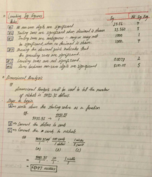
The scenario involves an archaeologist analyzing iron in an old building containing nickel-63, which has a known half-life of 92 years. With only 0.78% of the original nickel-63 remaining, the goal is to estimate the year when this discovery was made. We delve into the calculations and principles of first-order decay reactions.
Breaking Down Mixtures: Finding Mass Percent of Sodium Compounds
Want To Learn More? To watch the entire video and ALL of the videos in the series:
full solution
Uncover the method to determine mass percentages of Sodium Bromide and Sodium Sulfate in a mixture using the given Sodium content. Walk through a step-by-step calculation leveraging molar masses to derive the composition. Discover the resulting mass percentages: 23.85% for Sodium Bromide and 76.15% for Sodium Sulfate