PreparED Study Materials

CHE 112: Chemical Principles I
School: Illinois State University
Number of Notes and Study Guides Available: 0
Videos
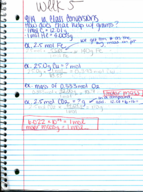
Calculate oxygen molar concentration in water at 25°C with a partial p

Want To Learn More? To watch the entire video and ALL of the videos in the series:
full solution
This video explores molar concentration (molarity) and demonstrates the calculation of oxygen's molar concentration in water at 25°C, considering a partial pressure of 0.22 atm by employing Henry's Law and the given Henry's Law constant for oxygen, revealing that under these conditions, there are 2.86 x 10?? moles of oxygen per liter of water, highlighting the significance of understanding these concepts for managing gas dissolution in liquids across varying circumstances.
CO?: Linear & Nonpolar with Temp Dipole Moments Explained!
Want To Learn More? To watch the entire video and ALL of the videos in the series:
full solution
Uncover the nuances of the CO? molecule's polarity and its electron dynamics. Understand how bending and stretching motions influence its electron density. Grasp the analogy of CO? to a jumping rope, highlighting its overall nonpolar nature.
Breaking Down Mixtures: Finding Mass Percent of Sodium Compounds
Want To Learn More? To watch the entire video and ALL of the videos in the series:
full solution
Uncover the method to determine mass percentages of Sodium Bromide and Sodium Sulfate in a mixture using the given Sodium content. Walk through a step-by-step calculation leveraging molar masses to derive the composition. Discover the resulting mass percentages: 23.85% for Sodium Bromide and 76.15% for Sodium Sulfate
Want To Learn More? To watch the entire video and ALL of the videos in the series:
full solution
Deriving the Perfect Gas Equation from Gas Laws
Want To Learn More? To watch the entire video and ALL of the videos in the series:
full solution
Learn how the ideal gas equation is derived from Boyle's law, Charles’ law, and Avogadro's principle, unraveling the fundamentals of gas behavior.
Identifying Fundamental Units in Rb?O, N?, Fe(NO?)?, and N?F?
Want To Learn More? To watch the entire video and ALL of the videos in the series:
full solution
In this exploration, we delve into the fundamental units of various substances, whether they are single atoms, molecules, or formula units. We examine ionic compounds like Rb?O and Fe(NO?)?, characterized by formula units as their basic components, and covalent compounds like N? and N?F?, where molecules are the fundamental units.
Textbook Solutions (0)
Top Selling Study Tools





Che140 lecture notes 10.5 - 10.9 (Chemistry)
CHE 140
Illinois State University
5 pages | Summer 2015