PreparED Study Materials

CHM 87981: General Chemistry for Engineers
School: Arizona State University
Number of Notes and Study Guides Available: 6
Notes




Videos
Positron Emission Nuclear Equations: Co-55, Na-22, F-18

Want To Learn More? To watch the entire video and ALL of the videos in the series:
full solution
Learn how to write nuclear equations for positron emission with Co-55, Na-22, and F-18. Explore the fascinating world of nuclear reactions.
Orthorhombic Unit Cell: Decoding Nickel Sulfate's Crystal Density
Want To Learn More? To watch the entire video and ALL of the videos in the series:
full solution
The video offers an insightful look into the orthorhombic unit cell, a unique crystal lattice structure. By exploring nickel sulfate's unit cell and its specific dimensions, we determine both the number of formula units and the density of this crystalline structure.
Molecular Geometries Explained: From N?O to PF? - Shape and Structure
Want To Learn More? To watch the entire video and ALL of the videos in the series:
full solution
Discover the distinct geometries of molecules like N?O, SO?, H?S, and PF?. Unravel the difference between molecular and electron shapes. Master the basics of linear, bent, tetrahedral, and trigonal pyramidal structures.
Ionic Character Comparison: Analyzing NaBr vs. HBr and BrCl vs. FCl
Want To Learn More? To watch the entire video and ALL of the videos in the series:
full solution
Discover the analysis of ionic character in compounds based on electronegativity differences. Learn about the contrasts between NaBr vs. HBr and BrCl vs. FCl. Grasp why NaBr and FCl showcase greater ionic character than their paired compounds.
Cyclohexane to Adipic Acid: Nylon's Yield Calculations
Want To Learn More? To watch the entire video and ALL of the videos in the series:
full solution
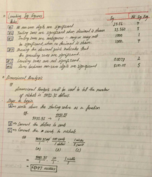
Explore the fascinating conversion of cyclohexane and oxygen into adipic acid, essential in nylon manufacture. This video breaks down the calculation of theoretical yield, actual yield, and the resultant percent yield of the process. From molar masses to intricate equations, get a concise understanding of this industrial reaction.
Understanding Microwaves: Boiling Water's Time and Photon Count
Want To Learn More? To watch the entire video and ALL of the videos in the series:
full solution
This video breaks down the process of calculating the time and number of photons required to boil water in a microwave. Using given power, wavelength, and water specifics, we determine both energy needs and photon count.