PreparED Study Materials
CHEM 111: General Chemistry 1
School: DCH Regional Medical Center
Number of Notes and Study Guides Available: 1
Notes
Videos
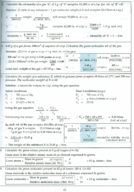
Mastering Unit Conversions: From Light-Years to Feet/sec

Want To Learn More? To watch the entire video and ALL of the videos in the series:
full solution
Learn how to convert between various units of measurement, ranging from cosmic distances to everyday lengths. The video takes viewers through the process of translating light-years into miles, yards into centimeters, and incredibly high speeds from cm/s to feet per second. Simplifying complex conversions, this guide offers clarity in the world of physics.
Shapes & Forces: How Molecule Structure Affects Bonds
Want To Learn More? To watch the entire video and ALL of the videos in the series:
full solution
Unveil the correlation between molecular shapes and their respective intermolecular forces. Delve into the specifics of nitrogen trichloride, ammonia, silane, and carbon tetrachloride, highlighting their unique force interactions based on polarity.
Why is a short RNA primer needed for replication?
Want To Learn More? To watch the entire video and ALL of the videos in the series:
full solution
Unlocking the Mystery of Short RNA Primers in DNA Replication: Discover the essential role they play and why they are a crucial component in the replication process. Join us in this video as we delve into the fascinating world of molecular biology and DNA replication.
Mastering Ionic and Net Ionic Equations for Varied Chemical Reactions
Want To Learn More? To watch the entire video and ALL of the videos in the series:
full solution
Discover the art of writing balanced, complete ionic, and net ionic equations for various chemical reactions. Learn the nuances that differentiate between these equations and watch them applied to diverse chemical reactants.
1828 Synthesis of Urea: Pioneering Steps in Biochemistry
Want To Learn More? To watch the entire video and ALL of the videos in the series:
full solution
Explore the groundbreaking moment in 1828 when Wöhler synthesized urea, the first organic compound. Join us in this video as we trace the profound impact of this achievement on the field of biochemistry and its significance in unraveling the mysteries of life's complex chemistry.
Synthesis, Decomposition Reactions, and Oxidation-Reduction
Want To Learn More? To watch the entire video and ALL of the videos in the series:
full solution
We explore synthesis and decomposition reactions, showcasing examples like the formation of water and its breakdown into simpler substances. We also clarify that while many of these reactions are redox reactions involving electron transfer, some synthesis and decomposition reactions may not necessarily be redox reactions, as seen in specific examples.