PreparED Study Materials

Notes
Videos
U-Tube Liquid Heights: Exploring Oil & Water Density Dynamics

Want To Learn More? To watch the entire video and ALL of the videos in the series:
full solution
Exploring the behavior of oil and water in a U-shaped tube when a barrier is removed. Understand the impact of differing densities on fluid heights. Witness equilibrium scenarios effects of equal densities and the displacement dynamics of lighter liquids.
Slinky Stretch: Calculating Transverse Wave Speed
Want To Learn More? To watch the entire video and ALL of the videos in the series:
full solution
Discover the fascinating world of Slinky physics as we explore the speed of transverse waves when this iconic toy is stretched by a 2.0-N force. Dive into the science behind the Slinky's behavior!
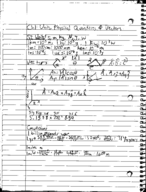
Calculating Displacement: West and South Travel
Want To Learn More? To watch the entire video and ALL of the videos in the series:
full solution
Learn how to calculate total displacement when traveling west and south at different speeds and durations. Explore the direction and magnitude of your journey in this informative video.
Flashlight Bulb Power and Battery Terminal Voltage
Want To Learn More? To watch the entire video and ALL of the videos in the series:
full solution
Illuminate the science of flashlight power! In this video, we explore how a 6V bulb is powered by a 3V battery with an internal resistance. We calculate the power dissipation of the bulb and the terminal voltage of the battery, unraveling the physics of electrical circuits.
Estimating Car's Initial Speed from Skid Marks: A Physics Explanation
Want To Learn More? To watch the entire video and ALL of the videos in the series:
full solution
Estimate a car's initial speed from skid marks using physics principles. Apply Newton's Second Law and equations of motion to deduce the initial velocity. Understand the role of frictional force in car deceleration during accidents.
Electromagnetic vs. Gravitational Forces: A Comparative Analysis
Want To Learn More? To watch the entire video and ALL of the videos in the series:
full solution
Explore the relative strengths of two fundamental forces, the electromagnetic force and the gravitational force, in this enlightening physics tutorial. Learn about Coulomb's law and Newton's law of gravitation, and uncover the significant difference in their constants that makes the electromagnetic force much more powerful than gravity.