PreparED Study Materials
CHEM 140: General Chemistry 1
School: DCH Regional Medical Center
Number of Notes and Study Guides Available: 0
Videos
Dimethylamine vs. Trimethylamine: Structures & Boiling Points

Want To Learn More? To watch the entire video and ALL of the videos in the series:
full solution
Uncover the science behind boiling points and molecular interactions in this video. Explore why Dimethylamine boils at a higher temperature than Trimethylamine, despite having a lower molecular weight, and gain insights into the role of molecular structures in determining physical properties.
Mole Fractions, Partial Pressures, and Total Pressure Calculation
Want To Learn More? To watch the entire video and ALL of the videos in the series:
full solution
Explore the calculations for mole fractions, partial pressures, and total pressure in a 22.4 dm³ vessel with H? and N? at 273.15 K.
Deriving the Perfect Gas Equation from Gas Laws
Want To Learn More? To watch the entire video and ALL of the videos in the series:
full solution
Learn how the ideal gas equation is derived from Boyle's law, Charles’ law, and Avogadro's principle, unraveling the fundamentals of gas behavior.
Denver Pressure Conversion: Atmospheres mmHg psi & Pascals Explained
Want To Learn More? To watch the entire video and ALL of the videos in the series:
full solution
Converting Denver's average pressure of 24.9 in. Hg into various units. This video provides clear steps to determine equivalents in millimeters of mercury atmospheres pounds per square inch and pascals. Understand the relationships and conversions between these common pressure units.
Nickel(II) Nitrate Solution Composition Analysis
Want To Learn More? To watch the entire video and ALL of the videos in the series:
full solution
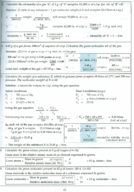
In this analysis, we determine the composition of a solution prepared by dissolving 12.15g of nickel(II) nitrate in 175mL of water (density 1.00 g/mL). The mass percent of nickel(II) nitrate is found to be approximately 6.50%, and the mole fraction of nickel(II) ions in the solution is calculated as 0.00672.
Perfecting Perbromate Ion: Achieving Zero Formal Charges
Want To Learn More? To watch the entire video and ALL of the videos in the series:
full solution
Learn how to create a Lewis structure for the perbromate ion, ensuring all atoms achieve zero formal charges. Follow the step-by-step guide to understand the bonding and electron distribution in this chemical compound.