PreparED Study Materials
CHEM 104: Second Semester Chemistry
School: DCH Regional Medical Center
Number of Notes and Study Guides Available: 0
Videos
Glycogen Synthesis and Phosphorylase Deactivation: Essential Mechanism

Want To Learn More? To watch the entire video and ALL of the videos in the series:
full solution
Delve into the intricate interplay between glycogen synthesis activation and glycogen phosphorylase deactivation. Discover the essential mechanisms that ensure the efficient management of glucose storage and utilization in the body.
Calculating [H?] in HNO? Solution Halfway to Equivalence with KOH
Want To Learn More? To watch the entire video and ALL of the videos in the series:
full solution
Unraveling HNO? Titration: Calculating [H?] Halfway with KOH. Harness the Henderson-Hasselbalch equation for pH determination. Discover the pH at midpoint between weak acid and strong base titration.
Diluting a 5.5 M KCl Solution to 0.100 M
Want To Learn More? To watch the entire video and ALL of the videos in the series:
full solution
Learn the steps to make a 2.5 L of 0.100 M KCl solution from a 5.5 M stock solution in this easy-to-follow tutorial.
Classifying Formaldehyde, Methanol, Dichloromethane & CO?: Polar or No
Want To Learn More? To watch the entire video and ALL of the videos in the series:
full solution
Explore the classification of select molecules based on their polarity. Understand the electron distribution and molecular shapes of Formaldehyde, Methanol, Dichloromethane, and Carbon dioxide. Discover which ones exhibit a net dipole moment and which ones don't.
Calculating Percent Composition: Using Molecular Formulas & Atomic Mas
Want To Learn More? To watch the entire video and ALL of the videos in the series:
full solution
Understand the process of calculating percent composition using the molecular formula. Grasp the methodology with compounds like C2H4O2, CH2O2, and more. Discover how atomic masses influence the mass percent of elements in various compounds.
0.800g Match to SO?: Volume Calculation at 725 Torr & 32°C!
Want To Learn More? To watch the entire video and ALL of the videos in the series:
full solution
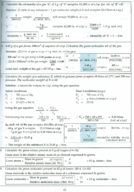
Detailed walkthrough of calculating sulfur dioxide gas volume produced from burning tetraphosphorus trisulfide. Utilizes stoichiometry and the Ideal Gas Law to derive results under specific conditions. Step-by-step guide for understanding chemical reactions and gas volume calculations