PreparED Study Materials

Notes
Videos
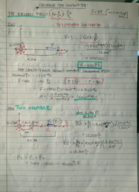
Hotel Peephole Lens: Achieving a 180-Degree View Through Refraction

Want To Learn More? To watch the entire video and ALL of the videos in the series:
full solution
Uncover the fascinating science behind peephole lenses, including the principles of light refraction and observer positioning that allow for an extensive field of vision through a hotel room door.
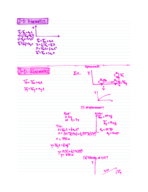
Capacitor Potential, Separation, and Work Calculations
Want To Learn More? To watch the entire video and ALL of the videos in the series:
full solution
Explore the concept of capacitance and learn how to calculate potential difference, the impact of separation, and the work required for a parallel-plate air capacitor.
Athlete's Power: Watts in a 5m Rope Climb
Want To Learn More? To watch the entire video and ALL of the videos in the series:
full solution
Explore the physics behind an athlete's rope climb. Understand the relationship between power, force, and time, and how to calculate the minimum power output an athlete exerts. Witness the interplay of physics principles in evaluating athletic prowess.
Unraveling Bead Motion: Force, Acceleration & Energy
Want To Learn More? To watch the entire video and ALL of the videos in the series:
full solution
Explore the dynamics of a bead under constant force. Understand its acceleration, velocity over time, and how to calculate its kinetic energy. Witness the interplay of motion equations and real-world applications in a simple system.
Determining Kinetic Friction with a Spring-Loaded Block
Want To Learn More? To watch the entire video and ALL of the videos in the series:
full solution
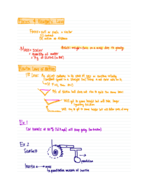
Understand how to determine the coefficient of kinetic friction using a wooden block and a spring. Employing the law of conservation of energy, we use the spring's compression and stretch measurements. Through energy equations and Newton's second law, we deduce that ? equals 0.4.
Electromagnetic vs. Gravitational Forces: A Comparative Analysis
Want To Learn More? To watch the entire video and ALL of the videos in the series:
full solution
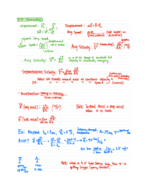
Explore the relative strengths of two fundamental forces, the electromagnetic force and the gravitational force, in this enlightening physics tutorial. Learn about Coulomb's law and Newton's law of gravitation, and uncover the significant difference in their constants that makes the electromagnetic force much more powerful than gravity.