PreparED Study Materials

CHEM 232: Organic Chemistry 2
School: Indiana University of Pennsylvania
Number of Notes and Study Guides Available: 1
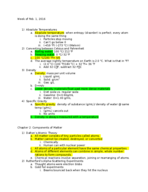
Notes
Videos
Unveiling Earth's Crust: Calculating Silicon Mass

Want To Learn More? To watch the entire video and ALL of the videos in the series:
full solution
Explore the fascinating process of calculating the mass of silicon in Earth's crust. Learn how to convert Earth's total mass to grams, determine the crust's mass percentage, and find the silicon's mass within the crust. Discover the scale of silicon's presence in our planet's outer layer.
Heat Absorption: Lead Weight's Final Temperature
Want To Learn More? To watch the entire video and ALL of the videos in the series:
full solution
Explore the process of heat absorption and discover how to calculate the final temperature of a lead fishing weight after absorbing a specific amount of heat.
Understanding Chlorine's Oxidation States in Complex Ions: A Step-by-S
Want To Learn More? To watch the entire video and ALL of the videos in the series:
full solution
Explore how to determine the oxidation states of Chlorine in various ions using fundamental rules in chemistry. Learn the importance of oxidation numbers in understanding chemical reactions and the art of balancing chemical equations.
Determining Base Concentration Using KHP: Indicator Choice Solution
Want To Learn More? To watch the entire video and ALL of the videos in the series:
full solution
Discover how to choose the right indicator for a titration involving Potassium hydrogen phthalate (KHP) and a strong base. Grasp the calculations from molar mass to pH and understand why Thymolphthalein is the ideal choice for a change near pH 8.95.
Calculate the Volume of 3.00 Moles of Kr(g) at STP
Want To Learn More? To watch the entire video and ALL of the videos in the series:
full solution
This video delves into the principles of gas behavior at standard temperature and pressure (STP) and how to determine the volume occupied by a given number of moles of gas under these conditions.
Ionic vs. Molecular: Classifying Compounds & Metal Ion Varieties!
Want To Learn More? To watch the entire video and ALL of the videos in the series:
full solution
Discover the art of classifying compounds as ionic or molecular based on bonding. Unravel the nuances between ionic and covalent bonds using electronegativity differences as a guide. Classify CoCl2 CF4 BaSO4 and NO with in-depth explanations and predict their properties.