PreparED Study Materials

CHM 205: Organic Chemistry II
School: Purdue University
Number of Notes and Study Guides Available: 1
Study Guides
Videos
Making a 0.150 M Ba(OH)? Solution: A Step-by-Step Guide

Want To Learn More? To watch the entire video and ALL of the videos in the series:
full solution
Learn how to calculate the amount of Barium hydroxide, Ba(OH)?, needed to prepare a specific molar concentration. This tutorial breaks down the relationship between moles of hydroxide ions and moles of Ba(OH)?, guiding users through each step for precise results. Embrace the essence of molarity in solution preparation.
Hypothesis to Theory: The Evolution of Scientific Understanding
Want To Learn More? To watch the entire video and ALL of the videos in the series:
full solution
Delve into the journey of scientific ideas as we discuss how a hypothesis can evolve into a theory, and whether a theory can ever become a law. Uncover the distinctions and connections between these fundamental elements of scientific understanding in this illuminating video.
Strong Base Comparison: H?S?, CH?O?, CH?OH, Cl?, CH?COO?, CH?CHClCOO
Want To Learn More? To watch the entire video and ALL of the videos in the series:
full solution
Explore the reactivity of different bases in this chemistry comparison. We'll analyze the strength of H?S?, CH?O?, CH?OH, Cl?, CH?COO?, and CH?CHClCOO? in various reactions.
Molecular Lewis Structures for CH?, CO?, H?Se, and NH?
Want To Learn More? To watch the entire video and ALL of the videos in the series:
full solution
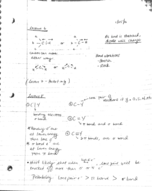
In this video, we demonstrate the creation of Lewis structures for methane, carbon dioxide, hydrogen selenide, and ammonia, highlighting the arrangement of atoms and bonds in each molecule. The video emphasizes the importance of Lewis structures in visualizing atomic bonding and the presence of lone electron pairs.
Understanding Boiling Points: Ethylene Glycol, Alcohols & Ethers Expla
Want To Learn More? To watch the entire video and ALL of the videos in the series:
full solution
This video offers insights into the properties and boiling points of different alcohols and ethers, including antifreeze agents like ethylene glycol. We also discuss how molecular structures and interactions impact boiling points, shedding light on key differences among related compounds.
Copper Bombardment: Calculating X-ray Photon Energy
Want To Learn More? To watch the entire video and ALL of the videos in the series:
full solution
We'll guide you through the process of calculating the energy associated with X-ray photons when the wavelength is 0.154 nm. This video offers a practical application of physics and helps you understand the energy spectrum of X-rays. Whether you're a science enthusiast or a student, you'll gain valuable insights into this intriguing topic.