PreparED Study Materials

PHYS 4013: Quantum Mechanics I
School: Arkansas Tech University
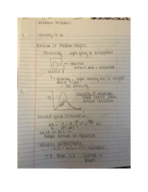
Number of Notes and Study Guides Available: 2
Notes

Videos
Geosynchronous Satellite Speed and Acceleration

Want To Learn More? To watch the entire video and ALL of the videos in the series:
full solution
Explore the fascinating world of geosynchronous satellites in this video. Learn how these communication satellites are strategically placed in circular orbits, staying directly over fixed points on the Earth's equator as our planet rotates. We delve into the physics behind these orbits, calculating the speed and acceleration of a satellite in geosynchronous orbit, using the Earth's radius and altitude as reference. Gain a deeper understanding of the science that enables global communications.
Critical Angle for Total Internal Reflection
Want To Learn More? To watch the entire video and ALL of the videos in the series:
full solution
Discover the magic of total internal reflection in this video! We explore how a ray of light refracts when traveling from glass into water. Find out the critical angle needed for total reflection, preventing any light from entering the water. Dive into the world of optics and refraction.
Track Radius for 5.5g Acceleration: Approximate Value
Want To Learn More? To watch the entire video and ALL of the videos in the series:
full solution
Delve into the physics of high-speed tracks and calculate the radius where drivers experience a 5.5g acceleration, exploring the multiple options and their implications.
Electric Watch Crystal: Frequency to Period Conversion
Want To Learn More? To watch the entire video and ALL of the videos in the series:
full solution
Uncover the secrets of watch crystals in this video! We convert the frequency of a quartz crystal used in electric watches into its period. Join us to explore the principles of timekeeping and crystal oscillations.
Adding Water to a Glass: Temperature Change Calculation
Want To Learn More? To watch the entire video and ALL of the videos in the series:
full solution
Watch as we explore the fascinating world of thermal expansion in this video. We start with a glass filled to the brim with 350.0 mL of water at a scorching 100.0°C, and then witness the magic unfold as the temperature decreases to a cool 20.0°C. But the real question is, how much more water can we add to the glass? Join us to find out!
Spherical Capacitor: Calculating Capacitance and Plate Area
Want To Learn More? To watch the entire video and ALL of the videos in the series:
full solution
Explore the concept of capacitance in a spherical capacitor and learn how to calculate it. Discover how to find the plate area for a parallel-plate capacitor with the same capacitance and separation.