
PreparED Study Materials

CHEM 1201: CHEM 1201
School: University of Colorado Colorado Springs
Number of Notes and Study Guides Available: 26
Notes


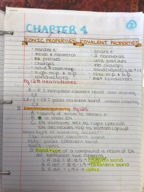
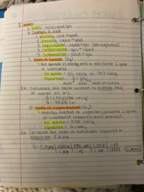
Chapter 10 notes (Chemistry)
CHEM 1201
University of Colorado Colorado Springs
5 pages | Winter 2016




Study Guides


Videos
Homogeneous vs Heterogeneous Mixtures: Examples & Classification Expla

Want To Learn More? To watch the entire video and ALL of the videos in the series:
full solution
Explore the distinction between homogeneous and heterogeneous mixtures. Through real-world examples like baby oil, chocolate chip cookies, and wine, understand their uniformity, phases, and how components are distributed.
Glycogen Synthesis and Phosphorylase Deactivation: Essential Mechanism
Want To Learn More? To watch the entire video and ALL of the videos in the series:
full solution
Delve into the intricate interplay between glycogen synthesis activation and glycogen phosphorylase deactivation. Discover the essential mechanisms that ensure the efficient management of glucose storage and utilization in the body.
Rutherford's Gold Foil: The Pivot to the Modern Nuclear Atom Model
Want To Learn More? To watch the entire video and ALL of the videos in the series:
full solution
Discover Rutherford's pivotal Gold Foil Experiment and its impact on atomic theory. Unveil the discrepancies with the Plum Pudding Model. Grasp the birth of the nuclear atom model through unexpected alpha particle deflections.
Constitution of Compounds: CH4O, CH3Cl, C2H6, CH5N, C2F6, C2H5Br, C3H8
Want To Learn More? To watch the entire video and ALL of the videos in the series:
full solution
Unraveling Molecular Structures: Explore the composition of compounds with molecular formulas CH4O, CH3Cl, C2H6, CH5N, C2F6, C2H5Br, and C3H8. Learn about their unique structures and properties.
Molar Mass Calculation: Sr(OH)2 N2O3 NaClO3 Cr2O3 Explained!
Want To Learn More? To watch the entire video and ALL of the videos in the series:
full solution
In this chemistry tutorial learn how to calculate the molar mass of various compounds using atomic masses from the periodic table. Discover the molar mass for compounds such as Strontium Hydroxide Dinitrogen Trioxide Sodium Chlorate and Chromium(III) Oxide. A concise guide to understanding molar masses and their real-world applications.
Drawing the Lewis Structure for Glycine: The Protein Building Block
Want To Learn More? To watch the entire video and ALL of the videos in the series:
full solution
Discover how amino acids, specifically glycine, form the foundation of proteins. Understand and visualize the Lewis structure representation of glycine. Grasp the significance of atomic bonding and electron distribution.
Textbook Solutions (0)
Top Selling Study Tools




Chapter 5 notes (Chemistry)
CHEM 3101
University of Colorado Colorado Springs
11 pages | Winter 2016


