PreparED Study Materials

CHE 220: Elemental Organic Chemistry
School: Illinois State University
Number of Notes and Study Guides Available: 3
Notes


Study Guides

Videos
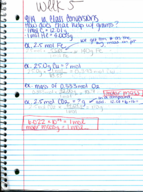
Aluminum & Iron(III) Oxide Reaction: Welding Heat & Calculations

Want To Learn More? To watch the entire video and ALL of the videos in the series:
full solution
Explore the chemical reaction between Aluminum and Iron (III) Oxide commonly used in welding. Learn to calculate the mass of Aluminum Oxide formed and identify the excess reagent. Dive deep into molar mass conversions stoichiometry and real-world applications in this chemistry tutorial.
Ranking WO? Rb?SO? Pb(C?H?O?)? RbI by Decreasing Formula Mass
Want To Learn More? To watch the entire video and ALL of the videos in the series:
full solution
Discover the method to rank compounds like Tungsten Dioxide Rubidium Sulfate Lead Acetate and Rubidium Iodide based on their formula masses. Learn about the significance and calculation of a compound's formula mass. Conclude with an ordered list from heaviest to lightest based on our calculations
Calculating Formula Masses: From Barium Bromide to Hydrobromic Acid
Want To Learn More? To watch the entire video and ALL of the videos in the series:
full solution
Understand the process of calculating formula masses for various compounds. This video breaks down the atomic masses for elements in barium bromide, dinitrogen trioxide, copper(I) sulfate, and hydrobromic acid. Master the method of summing up the masses considering atom count in each formula.
Comparing Bond Types: Ethane's Nonpolarity vs. Fluoromethane's Ionic L
Want To Learn More? To watch the entire video and ALL of the videos in the series:
full solution
Examine the nature of bonds in methylamine, ethane, fluoromethane, and methanol. Identify ethane's nonpolar covalent bond and understand why fluoromethane's bond leans toward the ionic spectrum. Grasp essential concepts in molecular bonding with this deep analysis.
What makes bubbles when water boils?
Want To Learn More? To watch the entire video and ALL of the videos in the series:
full solution
When water boils, bubbles rise to the surface, but what's in these bubbles? Let's evaluate the options. Option d, water vapor, is correct; the bubbles during boiling are primarily composed of water vapor, the gaseous state of water.
Calculate oxygen molar concentration in water at 25°C with a partial p
Want To Learn More? To watch the entire video and ALL of the videos in the series:
full solution
This video explores molar concentration (molarity) and demonstrates the calculation of oxygen's molar concentration in water at 25°C, considering a partial pressure of 0.22 atm by employing Henry's Law and the given Henry's Law constant for oxygen, revealing that under these conditions, there are 2.86 x 10?? moles of oxygen per liter of water, highlighting the significance of understanding these concepts for managing gas dissolution in liquids across varying circumstances.
Textbook Solutions (0)
Top Selling Study Tools




Che140 lecture notes 10.5 - 10.9 (Chemistry)
CHE 140
Illinois State University
5 pages | Summer 2015