PreparED Study Materials
CHEM 141: Principles of Chemistry
School: 1 MDSS-SGSLM-Langley AFB Advanced Education in General Dentistry 12 Months
Number of Notes and Study Guides Available: 2
Notes


Videos
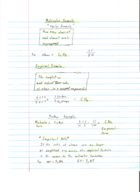
Mole Count in Elemental Samples (Zn, Ar, Ta, Li)

Want To Learn More? To watch the entire video and ALL of the videos in the series:
full solution
This video outlines the process of calculating the number of moles in various elemental samples. It begins by explaining the relationship between molar mass and atomic weight. Each sample's mass is divided by the respective element's molar mass to find the number of moles. It provides detailed calculations for four elemental samples: zinc (Zn), argon (Ar), tantalum (Ta), and lithium (Li), converting results to scientific notation where necessary. The script demonstrates how to determine the mole
Why geometric isomerism is not possible in alkynes
Want To Learn More? To watch the entire video and ALL of the videos in the series:
full solution
This video provides insights into the concept of geometric isomerism in organic chemistry and explains why alkynes, which contain carbon-carbon triple bonds and adopt a linear structure, cannot exhibit this form of isomerism, unlike alkenes with double bonds that restrict rotation.
Calculating Vapor Pressure & Its Lowering: Urea in Water at 35°C
Want To Learn More? To watch the entire video and ALL of the videos in the series:
full solution
Explore the intriguing process of determining the vapor pressure of a urea-water solution at 35°C. Using Raoult's law we'll calculate the mole fraction of water and urea leading to the solution's vapor pressure. Learn how the solution's composition affects vapor-pressure lowering
Using Avogadro's Number: Calculating Moles of Aluminum & Iron Atoms
Want To Learn More? To watch the entire video and ALL of the videos in the series:
full solution
Learn how to determine the number of moles in a given set of atoms using Avogadro's number. This tutorial breaks down the calculation for Aluminum and Iron, simplifying the concept for better understanding.
Metric Conversions: cm to m, g to kg, cm to mm, mL to L
Want To Learn More? To watch the entire video and ALL of the videos in the series:
full solution
Master metric unit conversions with step-by-step examples, including cm to meters, g to kilograms, cm to millimeters, and mL to liters.
Producing Ammonium Sulfate: Calculating the Required Ammonia
Want To Learn More? To watch the entire video and ALL of the videos in the series:
full solution
Discover the process to determine the quantity of ammonia (NH?) required to produce a specific amount of ammonium sulfate ((NH?)?SO?). Through a step-by-step explanation, learn the application of the balanced chemical equation and molar mass conversions. Transform theoretical chemistry into practical knowledge with this insightful guide.