PreparED Study Materials

CHEM 106: Contemporary Chemistry I
School: Tri-County Technical College
Number of Notes and Study Guides Available: 1
Notes

Videos
Glassware Drying with Acetone: The Science Behind It

Want To Learn More? To watch the entire video and ALL of the videos in the series:
full solution
This discussion delves into the use of acetone as a solvent for removing water from laboratory glassware, exploring the science behind its effectiveness and the role of hydrogen bonding in facilitating rapid evaporation.
Calculating Ksp for Ca3(PO4)2 at 25°C: Step-by-Step Guide
Want To Learn More? To watch the entire video and ALL of the videos in the series:
full solution
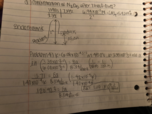
Unravel the concepts of 'Molar Solubility' and 'Solubility Product' to gauge salt solubility. Explore how Calcium Phosphate dissociates in solutions and calculate its unique Ksp value.
Comparing pH: Acid Concentrations Strength Ka pKa & pOH Explained!
Want To Learn More? To watch the entire video and ALL of the videos in the series:
full solution
Understanding pH Values: In this video we break down the pH levels of various solutions. Discover the importance of acid strengths via Ka and pKa contrast weak vs. strong acids and learn the counterintuitive relationship between pOH and pH.
Decoding Electron Configurations: From Rubidium to Argon Explained
Want To Learn More? To watch the entire video and ALL of the videos in the series:
full solution
Explore the intricacies of electron configurations around the atomic nucleus. Understand the ordered filling of energy levels in atoms like Rubidium, Germanium, and Argon. A deep look into the ground-state configurations of key elements.
Calculating [H?] in HNO? Solution Halfway to Equivalence with KOH
Want To Learn More? To watch the entire video and ALL of the videos in the series:
full solution
Unraveling HNO? Titration: Calculating [H?] Halfway with KOH. Harness the Henderson-Hasselbalch equation for pH determination. Discover the pH at midpoint between weak acid and strong base titration.
Mole Fractions, Partial Pressures, and Total Pressure Calculation
Want To Learn More? To watch the entire video and ALL of the videos in the series:
full solution
Explore the calculations for mole fractions, partial pressures, and total pressure in a 22.4 dm³ vessel with H? and N? at 273.15 K.