PreparED Study Materials

CHEM 192: Introductory Seminar/Chemistry
School: Colorado State University
Number of Notes and Study Guides Available: 0
Videos
Differentiating Strong & Weak Electrolytes: Ionization in Aqueous Solu

Want To Learn More? To watch the entire video and ALL of the videos in the series:
full solution
Discover the difference between strong and weak electrolytes by understanding their ionization in water. Using nitrous acid and nitric acid as examples, this video provides chemical equations that visually distinguish the ionization behavior of these electrolytes.
Dimethylamine vs. Trimethylamine: Structures & Boiling Points
Want To Learn More? To watch the entire video and ALL of the videos in the series:
full solution
Uncover the science behind boiling points and molecular interactions in this video. Explore why Dimethylamine boils at a higher temperature than Trimethylamine, despite having a lower molecular weight, and gain insights into the role of molecular structures in determining physical properties.
H-Cl Bond Energy Explained: ?H Signs Formation & Breakage Dynamics
Want To Learn More? To watch the entire video and ALL of the videos in the series:
full solution
Explore the concept of bond energy with the H-Cl bond as a prime example. Delve into the energy dynamics of bond breaking (endothermic positive ?H) versus bond formation (exothermic negative ?H). Understand how the magnitude remains consistent but signs differ based on energy absorption or release.
Mass Calc: C?F, MgF?, CS? & SO? Explained
Want To Learn More? To watch the entire video and ALL of the videos in the series:
full solution
Master the conversion of moles to grams with clear step-by-step guidance. Explore specific calculations for substances like carbon tetrafluoride and magnesium fluoride. Grasp the nuances of handling different units like millimoles and kilomoles in the context of substances such as carbon disulfide and sulfur trioxide
Predicting Precipitates: Al(NO?)? & NaOH Reaction Explained
Want To Learn More? To watch the entire video and ALL of the videos in the series:
full solution
Unlock the secrets of precipitation reactions as we mix Aluminium nitrate and Sodium hydroxide. Discover how Al(NO?)? and NaOH interact forming the insoluble Aluminium hydroxide Al(OH)?. Break down the net ionic equation to highlight only the active participants.
Decoding Compound Names: What's HNO2(aq) Called in Chemistry
Want To Learn More? To watch the entire video and ALL of the videos in the series:
full solution
Discover the process of naming acids based on their anions and oxidation states. This video breaks down the correct naming of HNO2(aq) by distinguishing its anion and determining its place in the world of mineral acids.
Textbook Solutions (0)
Top Selling Study Tools
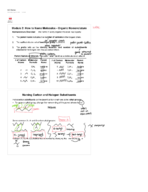

Chem 343 week 1 notes (8/22-8/26) (Chemistry)
CHEM 343
Colorado State University
7 pages | Fall 2015



Organic chemistry week 4 notes (Chemistry)
CHEM 341
Colorado State University
11 pages | Spring 2016