PreparED Study Materials

CHM 73464: General Chemistry for Engrs (Recitation)
School: Arizona State University
Number of Notes and Study Guides Available: 0
Videos
Calculate oxygen molar concentration in water at 25°C with a partial p

Want To Learn More? To watch the entire video and ALL of the videos in the series:
full solution
This video explores molar concentration (molarity) and demonstrates the calculation of oxygen's molar concentration in water at 25°C, considering a partial pressure of 0.22 atm by employing Henry's Law and the given Henry's Law constant for oxygen, revealing that under these conditions, there are 2.86 x 10?? moles of oxygen per liter of water, highlighting the significance of understanding these concepts for managing gas dissolution in liquids across varying circumstances.
Molecular Geometries Explained: From N?O to PF? - Shape and Structure
Want To Learn More? To watch the entire video and ALL of the videos in the series:
full solution
Discover the distinct geometries of molecules like N?O, SO?, H?S, and PF?. Unravel the difference between molecular and electron shapes. Master the basics of linear, bent, tetrahedral, and trigonal pyramidal structures.
Calculating MgO Mass from Oxygen Gas at STP
Want To Learn More? To watch the entire video and ALL of the videos in the series:
full solution
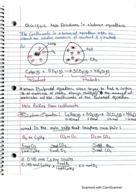
In this video, the problem involves calculating the mass of magnesium oxide (MgO) produced when 14.8 liters of oxygen gas react with magnesium metal according to the chemical equation 2Mg + O2 -> 2MgO. The stoichiometric relationship is used to determine that 0.6607 moles of oxygen gas results in 1.3214 moles of MgO, with a final calculation yielding a mass of 53.25 grams of MgO formed during the reaction at Standard Temperature and Pressure (STP).
Classifying Formaldehyde, Methanol, Dichloromethane & CO?: Polar or No
Want To Learn More? To watch the entire video and ALL of the videos in the series:
full solution
Explore the classification of select molecules based on their polarity. Understand the electron distribution and molecular shapes of Formaldehyde, Methanol, Dichloromethane, and Carbon dioxide. Discover which ones exhibit a net dipole moment and which ones don't.
Chemical Formulas for Barium Hydroxide, Magnesium Sulfite, and More
Want To Learn More? To watch the entire video and ALL of the videos in the series:
full solution
This video discusses the process of writing chemical formulas for different compounds, providing details on the types and charges of ions involved in each compound's composition. The video concludes with the chemical formulas for barium hydroxide, magnesium sulfite, calcium carbonate, ammonium sulfate, and lithium hydrogen carbonate.
Determining Ionizable H Atoms in Malonic Acid via Neutralization
Want To Learn More? To watch the entire video and ALL of the videos in the series:
full solution
Explore the process of determining ionizable hydrogen atoms in malonic acid using its molecular formula C3H4O4 and a neutralization reaction with Sodium hydroxide. Through methodical calculations involving the given mass of malonic acid and the required volume of Sodium hydroxide for neutralization we uncover that each molecule of malonic acid contains two ionizable H atoms.