PreparED Study Materials
CHEM 150: Physiological Chemistry
School: Xavier University
Number of Notes and Study Guides Available: 8
Notes




Study Guides


Videos
Predicting Precipitates: Al(NO?)? & NaOH Reaction Explained

Want To Learn More? To watch the entire video and ALL of the videos in the series:
full solution
Unlock the secrets of precipitation reactions as we mix Aluminium nitrate and Sodium hydroxide. Discover how Al(NO?)? and NaOH interact forming the insoluble Aluminium hydroxide Al(OH)?. Break down the net ionic equation to highlight only the active participants.
Decoding Ions: Al³?, S²?, I?, Ag? & Their Electron-Proton Dynamics
Want To Learn More? To watch the entire video and ALL of the videos in the series:
full solution
Break down the mysteries of ions like Al³?, S²?, I?, and Ag?. Discover how the electron count impacts ion charge by exploring Aluminium, Sulfur, Iodine, and Silver. Enhance your understanding of protons, electrons, and their relationship in ions.
Pure Substances vs. Mixtures: Classifying Based on Composition & Distr
Want To Learn More? To watch the entire video and ALL of the videos in the series:
full solution
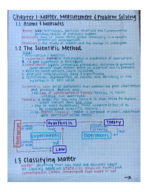
Understand the fundamental distinctions between pure substances and mixtures. Unpack the definitions and real-world examples of elements, compounds, homogeneous, and heterogeneous mixtures.
Barium Chloride & Sodium Sulfate: Calculating BaSO? Yield
Want To Learn More? To watch the entire video and ALL of the videos in the series:
full solution
Dive into the chemical reaction between Barium Chloride and Sodium Sulfate. Through step-by-step calculations, discover how to determine the resultant mass of Barium Sulfate. Conclude with a real-world example, highlighting the precise amount formed.
Rutherford's Gold Foil: The Pivot to the Modern Nuclear Atom Model
Want To Learn More? To watch the entire video and ALL of the videos in the series:
full solution
Discover Rutherford's pivotal Gold Foil Experiment and its impact on atomic theory. Unveil the discrepancies with the Plum Pudding Model. Grasp the birth of the nuclear atom model through unexpected alpha particle deflections.
Key Biochemical Concepts: Polymer, Protein, Nucleic Acid, Catalysis, G
Want To Learn More? To watch the entire video and ALL of the videos in the series:
full solution
In biochemistry, polymers are essential macromolecules, including carbohydrates, lipids, proteins, and nucleic acids, each adopting specific shapes and performing vital functions within cells, with proteins serving diverse roles, nucleic acids carrying genetic information, catalysis expediting reactions, and the genetic code enabling protein synthesis.