PreparED Study Materials

CHEM 31140: Preparatory Chemistry
School: University of California - Merced
Number of Notes and Study Guides Available: 2
Notes


Videos
Finding NaOH Molarity: Titration of 0.200L SO?-Derived H?SO? Solution

Want To Learn More? To watch the entire video and ALL of the videos in the series:
full solution
Determine the molarity of a NaOH solution through titration with sulfurous acid. Starting with the ideal gas equation we derive the concentration of a 0.200L SO?-derived H?SO? solution. Concluding with a molarity of 1.64 M for NaOH using calculated values.
Drawing Lewis Structures for Potassium, Barium, Aluminum, and Bromine
Want To Learn More? To watch the entire video and ALL of the videos in the series:
full solution
We explore Lewis structures, which depict atom bonding and lone electron pairs. We create Lewis structures for potassium, barium, aluminum, and bromine by using group numbers in the periodic table to determine their valence electrons.
Chromium & Oxygen: Limiting Reactants & Chromium(III) Oxide Formation
Want To Learn More? To watch the entire video and ALL of the videos in the series:
full solution
Unravel the reaction of chromium and oxygen forming chromium(III) oxide. Examine different scenarios to determine the limiting reactant using stoichiometric ratios. Understand how to predict product amounts through these calculations.
Making a 0.150 M Ba(OH)? Solution: A Step-by-Step Guide
Want To Learn More? To watch the entire video and ALL of the videos in the series:
full solution
Learn how to calculate the amount of Barium hydroxide, Ba(OH)?, needed to prepare a specific molar concentration. This tutorial breaks down the relationship between moles of hydroxide ions and moles of Ba(OH)?, guiding users through each step for precise results. Embrace the essence of molarity in solution preparation.
Understanding Key Assumptions of Kinetic Molecular Theory in Detail!
Want To Learn More? To watch the entire video and ALL of the videos in the series:
full solution
Dive into the Kinetic Molecular Theory of Matter understanding how atoms and molecules possess kinetic energy which we measure as temperature. Explore the five core assumptions including the constant random motion of gas particles and the relation between kinetic energy and temperature. Demystify the concepts of particle collisions intermolecular interactions and the universal behavior of gases at given temperatures
Want To Learn More? To watch the entire video and ALL of the videos in the series:
full solution
Textbook Solutions (0)
Top Selling Study Tools


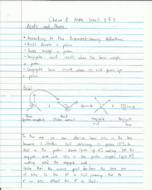



Chem 01, chapter 7 notes (Chemistry)
CHEM 001
University of California - Merced
1 page | Spring 2016