PreparED Study Materials

PHYS 193: College Physics I
School: Montclair State University
Number of Notes and Study Guides Available: 17
Notes


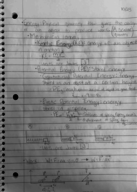


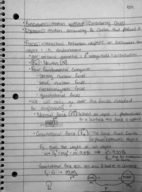


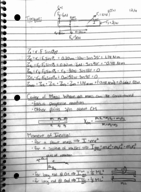


College physics i, chapter 5 notes (Physics)
PHYS 193
Montclair State University
8 pages | Fall 2016

Study Guides




College physics i, exam ii review (Physics)
PHYS 193
Montclair State University
17 pages | Fall 2016
Videos
Kinetic Energy: Saturn 5 & Apollo at 11.2 km/s Speed

Want To Learn More? To watch the entire video and ALL of the videos in the series:
full solution
Learn how to calculate the kinetic energy of a Saturn 5 rocket with an Apollo spacecraft attached using physics principles and formulas. Understand the importance of unit conversion and the work-energy theorem as you plug values into the KE = 1/2 mv² formula. Discover that the kinetic energy for this rocket and spacecraft combo is an astonishing 1.82 x 10¹³ Joules.
Time and Distance: Comparing 85 km/h and 115 km/h Cars
Want To Learn More? To watch the entire video and ALL of the videos in the series:
full solution
In this video, we explore the concept of time and distance as we compare two cars traveling at different speeds along a straight highway. We'll calculate when the faster car arrives at a destination 16 km away and find out how far they must travel for it to arrive 15 minutes before the slower car. Join us for an engaging journey through the world of physics and velocity!
Newton's Third Law and Force Pairs: System of Interest Impact
Want To Learn More? To watch the entire video and ALL of the videos in the series:
full solution
Delve into Newton's third law of motion and explore how the choice of the 'system of interest' influences whether force pairs cancel each other out.
Motorcycle vs. Bicycle Acceleration Comparison
Want To Learn More? To watch the entire video and ALL of the videos in the series:
full solution
Explore the fascinating comparison between the acceleration of a motorcycle going from 80 km/h to 90 km/h and a bicycle accelerating from rest to 10 km/h in the same time frame.
Orbit Altitude: Astronauts Above Planet's Surface
Want To Learn More? To watch the entire video and ALL of the videos in the series:
full solution
Embark on a celestial journey! In this video, we calculate the altitude above a distant planet's surface where a starship orbits. Discover how astronauts experience reduced free-fall acceleration and the fascinating dynamics of space travel.
Want To Learn More? To watch the entire video and ALL of the videos in the series:
full solution