PreparED Study Materials

CHEM 121: General Chemistry I
School: University of North Dakota
Number of Notes and Study Guides Available: 23
Notes













Study Guides

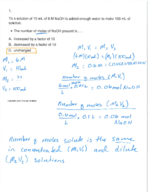


Chemistry study guide 10/17/2016 (Chemistry)
CHEM 121
University of North Dakota
5 pages | Fall 2016


Videos
Counting Atoms in Sulfur Dioxide: From Moles to Molecules

Want To Learn More? To watch the entire video and ALL of the videos in the series:
full solution
Learn the method to determine the count of SO? molecules, sulfur, and oxygen atoms from a given amount of sulfur dioxide (SO?). Understand the application of Avogadro's number in translating moles to molecules. Grasp key concepts of atomic structure and counting with hands-on examples.
Converting Various Units: Weight, Time, Height, and Volume
Want To Learn More? To watch the entire video and ALL of the videos in the series:
full solution
This video focuses on unit conversions and the practical use of conversion factors to translate quantities between different units. It provides clear examples of converting 70 kilograms to pounds, translating 14 billion years into seconds, changing the height of a basketball player from feet and inches to meters, and converting cubic meters to liters, illustrating the importance of this skill in various scientific and everyday scenarios.
What are the ground-state electron configurations of Ge, Fe, Zn, Ni, W
Want To Learn More? To watch the entire video and ALL of the videos in the series:
full solution
This video provides ground-state electron configurations for various elements, including germanium, iron, zinc, nickel, tungsten, and thallium, based on their atomic numbers.
CO?: Linear & Nonpolar with Temp Dipole Moments Explained!
Want To Learn More? To watch the entire video and ALL of the videos in the series:
full solution
Uncover the nuances of the CO? molecule's polarity and its electron dynamics. Understand how bending and stretching motions influence its electron density. Grasp the analogy of CO? to a jumping rope, highlighting its overall nonpolar nature.
Calculating the Mass Percent Composition of Chloroform (CHCl?)
Want To Learn More? To watch the entire video and ALL of the videos in the series:
full solution
In this video, we delve into the concept of percent composition by mass, exemplified through the compound chloroform (CHCl?), which was once employed as an inhalation anesthetic despite its associated toxicity. By calculating the percent composition for each element within the compound, we gain valuable insights into its composition and its potential effects on health and properties.
Determining Neutrons from Atomic & Mass Numbers: A Comprehensive Guide
Want To Learn More? To watch the entire video and ALL of the videos in the series:
full solution
Understand the relationship between atomic number, mass number, and neutrons within atoms. This video breaks down the simple calculation to determine the number of neutrons for specific elements like Nickel, Uranium, Scandium, and Argon.