PreparED Study Materials

CHE 2203: Organic Chemistry I Lab
School: Appalachian State University
Number of Notes and Study Guides Available: 1
Notes

Videos
Volume Calculation for Acetone, Olive Oil, and Chloroform

Want To Learn More? To watch the entire video and ALL of the videos in the series:
full solution
In this video, the presenter demonstrates the process of calculating the volume of 125g for three different liquids—Acetone, Olive oil, and Chloroform—using the formula "Volume = Mass / Density," providing step-by-step solutions for each liquid, ultimately revealing their respective volumes. This instructional video guides viewers through the calculations and showcases the outcome for each liquid's volume.
Molecule Count in 0.334 g of C?H?: Ethane Analysis
Want To Learn More? To watch the entire video and ALL of the videos in the series:
full solution
This instructional video guides you through the process of determining the number of molecules in a given sample. It illustrates the conversion from grams to moles using the molar mass of the substance and then to molecules using Avogadro's number, providing a practical example with ethane (C?H?) to calculate approximately 6.67 x 10²¹ molecules in a 0.334 g sample.
Reaction Unveiled: From Nitrogen Dioxide & Hydrogen to Ammonia & Water
Want To Learn More? To watch the entire video and ALL of the videos in the series:
full solution
Explore the intriguing reaction of gaseous Nitrogen Dioxide and Hydrogen, resulting in the formation of Ammonia and Water. Grasp the significance of balanced chemical equations in respecting the law of conservation of mass. Dive into the properties and characteristics of each involved compound.
Decoding Electron Configurations: From Rubidium to Argon Explained
Want To Learn More? To watch the entire video and ALL of the videos in the series:
full solution
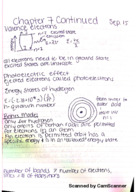
Explore the intricacies of electron configurations around the atomic nucleus. Understand the ordered filling of energy levels in atoms like Rubidium, Germanium, and Argon. A deep look into the ground-state configurations of key elements.
Molar Mass Calculation: Sr(OH)2 N2O3 NaClO3 Cr2O3 Explained!
Want To Learn More? To watch the entire video and ALL of the videos in the series:
full solution
In this chemistry tutorial learn how to calculate the molar mass of various compounds using atomic masses from the periodic table. Discover the molar mass for compounds such as Strontium Hydroxide Dinitrogen Trioxide Sodium Chlorate and Chromium(III) Oxide. A concise guide to understanding molar masses and their real-world applications.
Chromium(III) Oxide Reaction: Calculating Precise Quantities
Want To Learn More? To watch the entire video and ALL of the videos in the series:
full solution
Learn the art of precise chemical calculations in this video. Discover how Chromium(III) oxide reacts with hydrogen sulfide to form chromium(III) sulfide and water, all while unraveling the necessary steps to determine the exact quantities involved.