PreparED Study Materials

CHEM 8: Organic Chemistry
School: University of California - Santa Cruz
Number of Notes and Study Guides Available: 1
Notes
Videos
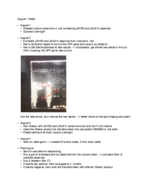
Rutherford's Gold Foil: The Pivot to the Modern Nuclear Atom Model

Want To Learn More? To watch the entire video and ALL of the videos in the series:
full solution
Discover Rutherford's pivotal Gold Foil Experiment and its impact on atomic theory. Unveil the discrepancies with the Plum Pudding Model. Grasp the birth of the nuclear atom model through unexpected alpha particle deflections.
Want To Learn More? To watch the entire video and ALL of the videos in the series:
full solution
Calculating [H?] in HNO? Solution Halfway to Equivalence with KOH
Want To Learn More? To watch the entire video and ALL of the videos in the series:
full solution
Unraveling HNO? Titration: Calculating [H?] Halfway with KOH. Harness the Henderson-Hasselbalch equation for pH determination. Discover the pH at midpoint between weak acid and strong base titration.
Identifying Redox Reactions & Agents: Four Chemistry Examples
Want To Learn More? To watch the entire video and ALL of the videos in the series:
full solution
Explore oxidation and reduction processes across four chemical reactions differentiating between acid-base and redox activities. Highlighting key substances and their roles in each reaction.
Nickel(II) Nitrate Solution Composition Analysis
Want To Learn More? To watch the entire video and ALL of the videos in the series:
full solution
In this analysis, we determine the composition of a solution prepared by dissolving 12.15g of nickel(II) nitrate in 175mL of water (density 1.00 g/mL). The mass percent of nickel(II) nitrate is found to be approximately 6.50%, and the mole fraction of nickel(II) ions in the solution is calculated as 0.00672.
Calculating Water's Freezing Point at Various Concentrations: A Chemis
Want To Learn More? To watch the entire video and ALL of the videos in the series:
full solution
Learn how to compute the freezing point of water at various solution concentrations using the freezing point depression formula. Uncover the relationship between concentration and the lowered freezing points for four distinct solutions. Equip yourself with essential knowledge on the effects of solute concentration on water's freezing behavior.