PreparED Study Materials

CHEM 1211L: Freshman Chemistry Laboratory I
School: University of Georgia
Number of Notes and Study Guides Available: 0
Videos
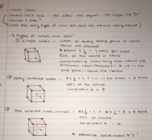
Tausonite's Unit Cell: Atoms & Formula Explained

Want To Learn More? To watch the entire video and ALL of the videos in the series:
full solution
Unpack the intricacies of solid-state chemistry, focusing on the unit cell structure of tausonite. Discover its empirical formula, atomic arrangement, and the unique coordination patterns of titanium and strontium with oxygen atoms.
Nickel(II) Nitrate Solution Composition Analysis
Want To Learn More? To watch the entire video and ALL of the videos in the series:
full solution
In this analysis, we determine the composition of a solution prepared by dissolving 12.15g of nickel(II) nitrate in 175mL of water (density 1.00 g/mL). The mass percent of nickel(II) nitrate is found to be approximately 6.50%, and the mole fraction of nickel(II) ions in the solution is calculated as 0.00672.
Counting Oxygen Atoms in Various Molecular Sets
Want To Learn More? To watch the entire video and ALL of the videos in the series:
full solution
Discover the simple yet essential method for counting the number of oxygen atoms in different molecular sets, including molecules and ions.
Decoding Electron Configurations: From Rubidium to Argon Explained
Want To Learn More? To watch the entire video and ALL of the videos in the series:
full solution
Explore the intricacies of electron configurations around the atomic nucleus. Understand the ordered filling of energy levels in atoms like Rubidium, Germanium, and Argon. A deep look into the ground-state configurations of key elements.
Heat Absorption: Lead Weight's Final Temperature
Want To Learn More? To watch the entire video and ALL of the videos in the series:
full solution
Explore the process of heat absorption and discover how to calculate the final temperature of a lead fishing weight after absorbing a specific amount of heat.
Understanding Reaction Rate Decrease Over Time
Want To Learn More? To watch the entire video and ALL of the videos in the series:
full solution
This explanation delves into the phenomenon where the reaction rate decreases over time due to the decrease in reactant concentration, resulting in fewer successful collisions and reactions, without revealing specific examples or findings.