PreparED Study Materials

CHM 2045: General Chemistry 1
School: University of Florida
Number of Notes and Study Guides Available: 4
Notes


Videos
Sketching Lewis Structures: Radical Species ClF? and BrO? Explained

Want To Learn More? To watch the entire video and ALL of the videos in the series:
full solution
This video elucidates the method to sketch Lewis structures for the radical species ClF? and BrO?. Highlighting the distinguishing feature of an unpaired electron, we illustrate the bond arrangements and lone pairs that define these unique chemical entities.
8 kJ to
Want To Learn More? To watch the entire video and ALL of the videos in the series:
full solution
Reaction Unveiled: From Nitrogen Dioxide & Hydrogen to Ammonia & Water
Want To Learn More? To watch the entire video and ALL of the videos in the series:
full solution
Explore the intriguing reaction of gaseous Nitrogen Dioxide and Hydrogen, resulting in the formation of Ammonia and Water. Grasp the significance of balanced chemical equations in respecting the law of conservation of mass. Dive into the properties and characteristics of each involved compound.
Determining Formula Mass: Step-by-Step Approach Using Atomic Masses
Want To Learn More? To watch the entire video and ALL of the videos in the series:
full solution
Discover the method to determine the formula mass for various compounds. Learn about the importance of atomic masses and their role in compounds like Aluminium sulfate, Diphosphorus Trioxide, and more. Understand the step-by-step approach to accurately calculate molecular weights.
Ranking WO? Rb?SO? Pb(C?H?O?)? RbI by Decreasing Formula Mass
Want To Learn More? To watch the entire video and ALL of the videos in the series:
full solution
Discover the method to rank compounds like Tungsten Dioxide Rubidium Sulfate Lead Acetate and Rubidium Iodide based on their formula masses. Learn about the significance and calculation of a compound's formula mass. Conclude with an ordered list from heaviest to lightest based on our calculations
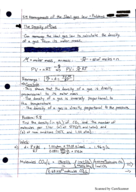
Calculating the Mass of CCl4: Using Density and Volume Insights
Want To Learn More? To watch the entire video and ALL of the videos in the series:
full solution
Learn the method to calculate the mass of a substance using its density and volume. This video demonstrates the practical application of density in determining the mass of carbon tetrachloride (CCl4) from a given volume.