PreparED Study Materials

CHEM 1: English
School: University of California - Santa Cruz
Number of Notes and Study Guides Available: 47
Notes


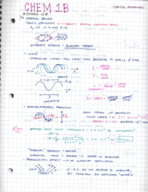

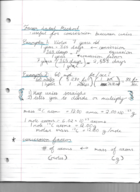




Study Guides



Videos
Differentiating Strong & Weak Electrolytes: Ionization in Aqueous Solu

Want To Learn More? To watch the entire video and ALL of the videos in the series:
full solution
Discover the difference between strong and weak electrolytes by understanding their ionization in water. Using nitrous acid and nitric acid as examples, this video provides chemical equations that visually distinguish the ionization behavior of these electrolytes.
Understanding Average Speed in Kinetic Molecular Theory
Want To Learn More? To watch the entire video and ALL of the videos in the series:
full solution
The kinetic molecular theory of gases describes the random motion and speed distribution of gas molecules in a container, and when considering various statements about the average speeds of these molecules, it's important to understand how they behave under different conditions.
Density Explained: Calculating the Density of an Osmium Cube
Want To Learn More? To watch the entire video and ALL of the videos in the series:
full solution
In this tutorial, we break down the principle of density, illustrating it as a measure of mass per unit volume. Using an osmium cube as a practical example, we walk viewers through the steps of computing its density, demonstrating the interplay between mass, volume, and particle arrangement.
Strong vs. Weak Acids: Ionization Differences in Water
Want To Learn More? To watch the entire video and ALL of the videos in the series:
full solution
Uncover the distinct behaviors of hydrochloric acid and acetic acid in water. Learn about the complete ionization of strong acids and the partial ionization of weak ones, emphasizing the differentiation in proton donation.
8 kJ to
Want To Learn More? To watch the entire video and ALL of the videos in the series:
full solution
Calculating MgO Mass from Oxygen Gas at STP
Want To Learn More? To watch the entire video and ALL of the videos in the series:
full solution
In this video, the problem involves calculating the mass of magnesium oxide (MgO) produced when 14.8 liters of oxygen gas react with magnesium metal according to the chemical equation 2Mg + O2 -> 2MgO. The stoichiometric relationship is used to determine that 0.6607 moles of oxygen gas results in 1.3214 moles of MgO, with a final calculation yielding a mass of 53.25 grams of MgO formed during the reaction at Standard Temperature and Pressure (STP).