PreparED Study Materials

CH 4101: Vet Tech Academic Exp
School: Mississippi State University
Number of Notes and Study Guides Available: 0
Videos
Understanding Microwaves: Boiling Water's Time and Photon Count

Want To Learn More? To watch the entire video and ALL of the videos in the series:
full solution
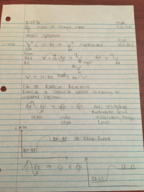
This video breaks down the process of calculating the time and number of photons required to boil water in a microwave. Using given power, wavelength, and water specifics, we determine both energy needs and photon count.
Want To Learn More? To watch the entire video and ALL of the videos in the series:
full solution
Want To Learn More? To watch the entire video and ALL of the videos in the series:
full solution
Understanding Reaction Rate Decrease Over Time
Want To Learn More? To watch the entire video and ALL of the videos in the series:
full solution
This explanation delves into the phenomenon where the reaction rate decreases over time due to the decrease in reactant concentration, resulting in fewer successful collisions and reactions, without revealing specific examples or findings.
Synthesis, Decomposition Reactions, and Oxidation-Reduction
Want To Learn More? To watch the entire video and ALL of the videos in the series:
full solution
We explore synthesis and decomposition reactions, showcasing examples like the formation of water and its breakdown into simpler substances. We also clarify that while many of these reactions are redox reactions involving electron transfer, some synthesis and decomposition reactions may not necessarily be redox reactions, as seen in specific examples.
Number of molecules in 3.5g H?O, 56.1g N?, 89g CCl?, 19g C?H??O?
Want To Learn More? To watch the entire video and ALL of the videos in the series:
full solution
This video shows how to determine the number of molecules in a given sample by utilizing the concept of moles, Avogadro's number (6.022 x 10²³), and the molar mass of the substance. It provides step-by-step calculations for different substances, converting mass to the number of molecules and highlighting the versatile application of this approach.