

Determine the moment of inertia about the x axis.
Read moreTextbook Solutions for Engineering Mechanics: Statics
Chapter 10 Problem 10-68
Question
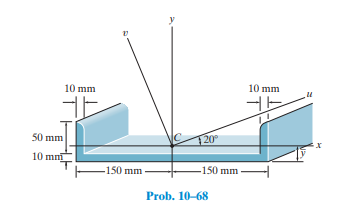
Determine the distance \((\bar{y}\) to the centroid of the area and then calculate the moments of inertia Iu and Iv of the channel’s cross-sectional area. The \(I_{u}\) and \(I_{v}\) axes have their origin at the centroid C. For the calculation, assume all corners to be square
Solution
Step 1 of 9
Redraw the diagram of the with the sections as
Subscribe to view the
full solution
full solution
Title
Engineering Mechanics: Statics 14
Author
Russell C. Hibbeler
ISBN
9780133918922
Solution: Determine the distance y to the centroid of the
Chapter 10 textbook questions
-
Chapter 10: Problem 10 Engineering Mechanics: Statics 14
-
Chapter 10: Problem 10 Engineering Mechanics: Statics 14
Determine the moment of inertia about the y axis
Read more -
Chapter 10: Problem 10 Engineering Mechanics: Statics 14
Determine the moment of inertia for the shaded area about the x axis
Read more -
Chapter 10: Problem 10 Engineering Mechanics: Statics 14
Determine the moment of inertia for the shaded area about the y axis.
Read more -
Chapter 10: Problem 10 Engineering Mechanics: Statics 14
Determine the moment of inertia for the shaded area about the x axis
Read more -
Chapter 10: Problem 10 Engineering Mechanics: Statics 14
Determine the moment of inertia for the shaded area about the y axis.
Read more -
Chapter 10: Problem 10 Engineering Mechanics: Statics 14
Determine the moment of inertia for the shaded area about the x axis.
Read more -
Chapter 10: Problem 10 Engineering Mechanics: Statics 14
Determine the moment of inertia for the shaded area about the y axis.
Read more -
Chapter 10: Problem 10 Engineering Mechanics: Statics 14
Determine the moment of inertia of the area about the x axis. Solve the problem in two ways, using rectangular differential elements: (a) having a thickness dx and (b) having a thickness of dy.
Read more -
Chapter 10: Problem 10 Engineering Mechanics: Statics 14
Determine the moment of inertia of the area about the x axis
Read more -
Chapter 10: Problem 10 Engineering Mechanics: Statics 14
Determine the moment of inertia for the shaded area about the x axis.
Read more -
Chapter 10: Problem 10 Engineering Mechanics: Statics 14
Determine the moment of inertia for the shaded area about the y axis.
Read more -
Chapter 10: Problem 10 Engineering Mechanics: Statics 14
Determine the moment of inertia about the x axis.
Read more -
Chapter 10: Problem 10 Engineering Mechanics: Statics 14
Determine the moment of inertia about the y axis
Read more -
Chapter 10: Problem 10 Engineering Mechanics: Statics 14
Determine the moment of inertia for the shaded area about the x axis.
Read more -
Chapter 10: Problem 10 Engineering Mechanics: Statics 14
Determine the moment of inertia for the shaded area about the y axis.
Read more -
Chapter 10: Problem 10 Engineering Mechanics: Statics 14
Determine the moment of inertia for the shaded area about the x axis.
Read more -
Chapter 10: Problem 10 Engineering Mechanics: Statics 14
Determine the moment of inertia for the shaded area about the y axis.
Read more -
Chapter 10: Problem 10 Engineering Mechanics: Statics 14
Determine the moment of inertia for the shaded area about the x axis
Read more -
Chapter 10: Problem 10 Engineering Mechanics: Statics 14
Determine the moment of inertia for the shaded area about the y axis
Read more -
Chapter 10: Problem 10 Engineering Mechanics: Statics 14
Determine the moment of inertia for the shaded area about the x axis.
Read more -
Chapter 10: Problem 10 Engineering Mechanics: Statics 14
Determine the moment of inertia for the shaded area about the y axis.
Read more -
Chapter 10: Problem 10 Engineering Mechanics: Statics 14
Determine the moment of inertia for the shaded area about the x axis
Read more -
Chapter 10: Problem 10 Engineering Mechanics: Statics 14
Determine the moment of inertia for the shaded area about the y axis.
Read more -
Chapter 10: Problem 10 Engineering Mechanics: Statics 14
Determine the moment of inertia of the composite area about the x axis.
Read more -
Chapter 10: Problem 10 Engineering Mechanics: Statics 14
Determine the moment of inertia of the composite area about the y axis
Read more -
Chapter 10: Problem 10 Engineering Mechanics: Statics 14
The polar moment of inertia for the area is \(J_{C}=642\left(10^{6}\right) \mathrm{mm}^{4}\), about the z’ axis passing through the centroid C. The moment of inertia about the y’ axis is \(264\left(10^{6}\right) \mathrm{mm}^{4}\), and the moment of inertia about the x axis is \(938\left(10^{6}\right) \mathrm{mm}^{4}\). Determine the area A
Read more -
Chapter 10: Problem 10 Engineering Mechanics: Statics 14
Determine the location \((\bar{y}\) of the centroid of the channel’s cross-sectional area and then calculate the moment of inertia of the area about this axis.
Read more -
Chapter 10: Problem 10 Engineering Mechanics: Statics 14
Determine \((\bar{y}\), which locates the centroidal axis x’ for the cross-sectional area of the T-beam, and then find the moments of inertia \(I_{x}\) and \(I_{y}\).
Read more -
Chapter 10: Problem 10 Engineering Mechanics: Statics 14
Determine the moment of inertia for the beam’s cross-sectional area about the x axis.
Read more -
Chapter 10: Problem 10 Engineering Mechanics: Statics 14
Determine the moment of inertia for the beam’s cross-sectional area about the y axis.
Read more -
Chapter 10: Problem 10 Engineering Mechanics: Statics 14
Determine the moment of inertia \(I_{x}\) of the shaded area about the x axis
Read more -
Chapter 10: Problem 10 Engineering Mechanics: Statics 14
Determine the moment of inertia \(I_{x}\)x of the shaded area about the y axis.
Read more -
Chapter 10: Problem 10 Engineering Mechanics: Statics 14
Determine the moment of inertia of the beam’s cross-sectional area about the y axis.
Read more -
Chapter 10: Problem 10 Engineering Mechanics: Statics 14
Determine \((\bar{y}\), which locates the centroidal axis x’ for the cross-sectional area of the T-beam, and then find the moment of inertia about the x’ axis.
Read more -
Chapter 10: Problem 10 Engineering Mechanics: Statics 14
Determine the moment of inertia about the x axis.
Read more -
Chapter 10: Problem 10 Engineering Mechanics: Statics 14
Determine the moment of inertia about the y axis.
Read more -
Chapter 10: Problem 10 Engineering Mechanics: Statics 14
Determine the moment of inertia of the shaded area about the x axis.
Read more -
Chapter 10: Problem 10 Engineering Mechanics: Statics 14
Determine the moment of inertia of the shaded area about the y axis
Read more -
Chapter 10: Problem 10 Engineering Mechanics: Statics 14
Determine the distance \((\bar{y}\) to the centroid of the beam’s cross-sectional area; then find the moment of inertia about the centroidal x’ axis
Read more -
Chapter 10: Problem 10 Engineering Mechanics: Statics 14
Determine the moment of inertia for the beam’s cross-sectional area about the y axis
Read more -
Chapter 10: Problem 10 Engineering Mechanics: Statics 14
Determine the moment of inertia of the beam’s cross-sectional area about the x axis.
Read more -
Chapter 10: Problem 10 Engineering Mechanics: Statics 14
Determine the moment of inertia of the beam’s cross-sectional area about the y axis.
Read more -
Chapter 10: Problem 10 Engineering Mechanics: Statics 14
Determine the distance \((\bar{y}\) to the centroid C of the beam’s cross-sectional area and then compute the moment of inertia \(\bar{I}_{x}\) about the x’ axis
Read more -
Chapter 10: Problem 10 Engineering Mechanics: Statics 14
Determine the distance \((\bar{x}\) to the centroid C of the beam’s cross-sectional area and then compute the moment of inertia \(\bar{I}_{y}\) about the y’ axis
Read more -
Chapter 10: Problem 10 Engineering Mechanics: Statics 14
Determine the moment of inertia for the shaded area about the x axis.
Read more -
Chapter 10: Problem 10 Engineering Mechanics: Statics 14
Determine the moment of inertia of the shaded area about the y axis
Read more -
Chapter 10: Problem 10 Engineering Mechanics: Statics 14
Determine the moment of inertia of the parallelogram about the x’ axis, which passes through the centroid C of the area.
Read more -
Chapter 10: Problem 10 Engineering Mechanics: Statics 14
Determine the moment of inertia of the parallelogram about the y’ axis, which passes through the centroid C of the area
Read more -
Chapter 10: Problem 10 Engineering Mechanics: Statics 14
Locate the centroid \((\bar{y}\) of the cross section and determine the moment of inertia of the section about the x’ axis
Read more -
Chapter 10: Problem 10 Engineering Mechanics: Statics 14
Determine the moment of inertia for the beam’s cross-sectional area about the x’ axis passing through the centroid C of the cross section
Read more -
Chapter 10: Problem 10 Engineering Mechanics: Statics 14
Determine the moment of inertia of the area about the x axis.
Read more -
Chapter 10: Problem 10 Engineering Mechanics: Statics 14
Determine the moment of inertia of the area about the y axis.
Read more -
Chapter 10: Problem 10 Engineering Mechanics: Statics 14
Determine the product of inertia of the thin strip of area with respect to the x and y axes. The strip is oriented at an angle \(\theta\) from the x axis. Assume that \(t \ll\) l.
Read more -
Chapter 10: Problem 10 Engineering Mechanics: Statics 14
Determine the product of inertia of the shaded area with respect to the x and y axes.
Read more -
Chapter 10: Problem 10 Engineering Mechanics: Statics 14
Determine the product of inertia for the shaded portion of the parabola with respect to the x and y axes.
Read more -
Chapter 10: Problem 10 Engineering Mechanics: Statics 14
Determine the product of inertia of the shaded area with respect to the x and y axes, and then use the parallel-axis theorem to find the product of inertia of the area with respect to the centroidal x’ and y’ axes.
Read more -
Chapter 10: Problem 10 Engineering Mechanics: Statics 14
Determine the product of inertia for the parabolic area with respect to the x and y axes
Read more -
Chapter 10: Problem 10 Engineering Mechanics: Statics 14
Determine the product of inertia of the shaded area with respect to the x and y axes.
Read more -
Chapter 10: Problem 10 Engineering Mechanics: Statics 14
Determine the product of inertia of the shaded area with respect to the x and y axes.
Read more -
Chapter 10: Problem 10 Engineering Mechanics: Statics 14
Determine the product of inertia of the shaded area with respect to the x and y axes.
Read more -
Chapter 10: Problem 10 Engineering Mechanics: Statics 14
Determine the product of inertia for the beam’s cross-sectional area with respect to the x and y axes.
Read more -
Chapter 10: Problem 10 Engineering Mechanics: Statics 14
Determine the moments of inertia of the shaded area with respect to the u and v axes.
Read more -
Chapter 10: Problem 10 Engineering Mechanics: Statics 14
Determine the product of inertia for the beam’s cross-sectional area with respect to the u and v axes.
Read more -
Chapter 10: Problem 10 Engineering Mechanics: Statics 14
Determine the product of inertia for the shaded area with respect to the x and y axes
Read more -
Chapter 10: Problem 10 Engineering Mechanics: Statics 14
Determine the product of inertia of the crosssectional area with respect to the x and y axes.
Read more -
Chapter 10: Problem 10 Engineering Mechanics: Statics 14
Determine the location \((\bar{x}, \bar{y})\) to the centroid C of the angle’s cross-sectional area, and then compute the product of inertia with respect to the x’ and y’ axes.
Read more -
Chapter 10: Problem 10 Engineering Mechanics: Statics 14
Determine the distance \((\bar{y}\) to the centroid of the area and then calculate the moments of inertia Iu and Iv of the channel’s cross-sectional area. The \(I_{u}\) and \(I_{v}\) axes have their origin at the centroid C. For the calculation, assume all corners to be square
Read more -
Chapter 10: Problem 10 Engineering Mechanics: Statics 14
Determine the moments of inertia \(I_{u}\), \(I_{v}\) and the product of inertia \(I_{uv}\) for the beam’s cross-sectional area. Take \(\theta=45^{\circ}\).
Read more -
Chapter 10: Problem 10 Engineering Mechanics: Statics 14
Determine the moments of inertia \(I_{u}\), \(I_{v}\) and the product of inertia \(I_{uv}\) for the rectangular area. The u and v axes pass through the centroid C.
Read more -
Chapter 10: Problem 10 Engineering Mechanics: Statics 14
Solve Prob. 10–70 using Mohr’s circle. Hint: To solve, find the coordinates of the point \(P\left(I_{u}, I_{u v}\right)\) on the circle, measured counterclockwise from the radial line OA. (See Fig. 10–19.) The point \(Q\left(I_{v},-I_{u v}\right)\) is on the opposite side of the circle
Read more -
Chapter 10: Problem 10 Engineering Mechanics: Statics 14
Determine the directions of the principal axes having an origin at point O, and the principal moments of inertia for the triangular area about the axes.
Read more -
Chapter 10: Problem 10 Engineering Mechanics: Statics 14
Solve Prob. 10–72 using Mohr’s circle.
Read more -
Chapter 10: Problem 10 Engineering Mechanics: Statics 14
Determine the orientation of the principal axes having an origin at point C, and the principal moments of inertia of the cross section about these axes.
Read more -
Chapter 10: Problem 10 Engineering Mechanics: Statics 14
Solve Prob. 10–74 using Mohr’s circle.
Read more -
Chapter 10: Problem 10 Engineering Mechanics: Statics 14
Determine the orientation of the principal axes having an origin at point O, and the principal moments of inertia for the rectangular area about these axes.
Read more -
Chapter 10: Problem 10 Engineering Mechanics: Statics 14
Solve Prob. 10–76 using Mohr’s circle
Read more -
Chapter 10: Problem 10 Engineering Mechanics: Statics 14
The area of the cross section of an airplane wing has the following properties about the x and y axes passing through the centroid C: \(\bar{I}_{x}=450 \mathrm{in}^{4}, \quad \bar{I}_{y}=1730 \mathrm{in}^{4}\), \(\bar{I}_{x y}=138 \mathrm{in}^{4}\). Determine the orientation of the principal axes and the principal moments of inertia.
Read more -
Chapter 10: Problem 10 Engineering Mechanics: Statics 14
Solve Prob. 10–78 using Mohr’s circle.
Read more -
Chapter 10: Problem 10 Engineering Mechanics: Statics 14
Determine the moments and product of inertia for the shaded area with respect to the u and v axes
Read more -
Chapter 10: Problem 10 Engineering Mechanics: Statics 14
Solve Prob. 10–80 using Mohr’s circle.
Read more -
Chapter 10: Problem 10 Engineering Mechanics: Statics 14
Determine the directions of the principal axes with origin located at point O, and the principal moments of inertia for the area about these axes
Read more -
Chapter 10: Problem 10 Engineering Mechanics: Statics 14
Solve Prob. 10–82 using Mohr’s circle
Read more -
Chapter 10: Problem 10 Engineering Mechanics: Statics 14
Determine the moment of inertia of the thin ring about the z axis. The ring has a mass m.
Read more -
Chapter 10: Problem 10 Engineering Mechanics: Statics 14
Determine the moment of inertia of the ellipsoid with respect to the x axis and express the result in terms of the mass m of the ellipsoid. The material has a constant density \(\rho\)
Read more -
Chapter 10: Problem 10 Engineering Mechanics: Statics 14
Determine the radius of gyration \(k_{x}\) of the paraboloid. The density of the material is \(\rho\) = 5 Mg/\(m^{3}\) .
Read more -
Chapter 10: Problem 10 Engineering Mechanics: Statics 14
The paraboloid is formed by revolving the shaded area around the x axis. Determine the moment of inertia about the x axis and express the result in terms of the total mass m of the paraboloid. The material has a constant density \(\rho\).
Read more -
Chapter 10: Problem 10 Engineering Mechanics: Statics 14
Determine the moment of inertia of the homogenous triangular prism with respect to the y axis. Express the result in terms of the mass m of the prism. Hint: For integration, use thin plate elements parallel to the x–y plane having a thickness of dz.
Read more -
Chapter 10: Problem 10 Engineering Mechanics: Statics 14
Determine the moment of inertia of the semiellipsoid with respect to the x axis and express the result in terms of the mass m of the semiellipsoid. The material has a constant density \(\rho\)
Read more -
Chapter 10: Problem 10 Engineering Mechanics: Statics 14
Determine the radius of gyration \(k_{x}\) of the solid formed by revolving the shaded area about x axis. The density of the material is \(\rho\).
Read more -
Chapter 10: Problem 10 Engineering Mechanics: Statics 14
The concrete shape is formed by rotating the shaded area about the y axis. Determine the moment of inertia\(\bar{I}_{y}\). The specific weight of concrete is \(\gamma\) = 150 lb/\(ft^{3}\) .
Read more -
Chapter 10: Problem 10 Engineering Mechanics: Statics 14
Determine the moment of inertia \(\bar{I}_{x}\) of the sphere and express the result in terms of the total mass m of the sphere. The sphere has a constant density \(\rho\).
Read more -
Chapter 10: Problem 10 Engineering Mechanics: Statics 14
The right circular cone is formed by revolving the shaded area around the x axis. Determine the moment of inertia \(\bar{I}_{x}\) and express the result in terms of the total mass m of the cone. The cone has a constant density \(\rho\)
Read more -
Chapter 10: Problem 10 Engineering Mechanics: Statics 14
Determine the mass moment of inertia \(\bar{I}_{y}\) of the solid formed by revolving the shaded area around the y axis. The total mass of the solid is 1500 kg.
Read more -
Chapter 10: Problem 10 Engineering Mechanics: Statics 14
The slender rods have a mass of 4 kg/m. Determine the moment of inertia of the assembly about an axis perpendicular to the page and passing through point A.
Read more -
Chapter 10: Problem 10 Engineering Mechanics: Statics 14
The pendulum consists of a 8-kg circular disk A, a 2-kg circular disk B, and a 4-kg slender rod. Determine the radius of gyration of the pendulum about an axis perpendicular to the page and passing through point O.
Read more -
Chapter 10: Problem 10 Engineering Mechanics: Statics 14
Determine the moment of inertia \(\bar{I}_{z}\) of the frustum of the cone which has a conical depression. The material has a density of 200 kg/\(m^{3}\)
Read more -
Chapter 10: Problem 10 Engineering Mechanics: Statics 14
The pendulum consists of the 3-kg slender rod and the 5-kg thin plate. Determine the location \((\bar{y}\) of the center of mass G of the pendulum; then find the mass moment of inertia of the pendulum about an axis perpendicular to the page and passing through G
Read more -
Chapter 10: Problem 10 Engineering Mechanics: Statics 14
Determine the mass moment of inertia of the thin plate about an axis perpendicular to the page and passing through point O. The material has a mass per unit area of 20 kg/\(m^{2}\)
Read more -
Chapter 10: Problem 10 Engineering Mechanics: Statics 14
The pendulum consists of a plate having a weight of 12 lb and a slender rod having a weight of 4 lb. Determine the radius of gyration of the pendulum about an axis perpendicular to the page and passing through point O.
Read more -
Chapter 10: Problem 10 Engineering Mechanics: Statics 14
If the large ring, small ring and each of the spokes weigh 100 lb, 15 lb, and 20 lb, respectively, determine the mass moment of inertia of the wheel about an axis perpendicular to the page and passing through point A.
Read more -
Chapter 10: Problem 10 Engineering Mechanics: Statics 14
Determine the mass moment of inertia of the assembly about the z axis. The density of the material is 7.85 Mg/\(m^{3}\).
Read more -
Chapter 10: Problem 10 Engineering Mechanics: Statics 14
Each of the three slender rods has a mass m. Determine the moment of inertia of the assembly about an axis that is perpendicular to the page and passes through the center point O.
Read more -
Chapter 10: Problem 10 Engineering Mechanics: Statics 14
The thin plate has a mass per unit area of 10 kg/\(m^{2}\) . Determine its mass moment of inertia about the y axis.
Read more -
Chapter 10: Problem 10 Engineering Mechanics: Statics 14
The thin plate has a mass per unit area of 10 kg/\(m^{2}\) . Determine its mass moment of inertia about the z axis.
Read more -
Chapter 10: Problem 10 Engineering Mechanics: Statics 14
Determine the moment of inertia of the assembly about an axis that is perpendicular to the page and passes through the center of mass G. The material has a specific weight of \(\gamma\) = 90 lb/\(ft^{3}\) .
Read more -
Chapter 10: Problem 10 Engineering Mechanics: Statics 14
Determine the moment of inertia of the assembly about an axis that is perpendicular to the page and passes through point O. The material has a specific weight of \(\gamma\) = 90 lb/\(ft^{3}\) ..
Read more -
Chapter 10: Problem 10 Engineering Mechanics: Statics 14
The pendulum consists of two slender rods AB and OC which have a mass of 3 kg/m. The thin plate has a mass of 12 kg/\(m^{2}\). Determine the location y of the center of mass G of the pendulum, then calculate the moment of inertia of the pendulum about an axis perpendicular to the page and passing through G
Read more -
Chapter 10: Problem 10 Engineering Mechanics: Statics 14
Determine the moment of inertia \(\bar{I}_{z}\) of the frustum of the cone which has a conical depression. The material has a density of 200 kg/\(m^{3}\) .
Read more