
Under the same assumptions underlying the model in (1), determine a differential equation governing the growing population P(t) of a country when individuals are allowed to immigrate into the country at a constant rate r > 0. What is the differential equation for the population P(t) of the country when individuals are allowed to emigrate at a constant rate r > 0?
Read moreTable of Contents
Appendix I
Derivative and Integral Formulas
Appendix II
Gamma Function
Appendix III
Table of Laplace Transforms
1
Introduction to Differential Equations
1.1
Definitions and Terminology
1.2
Initial-Value Problems
1.3
Differential Equations as Mathematical Models
2
First-Order Differential Equations
2.1
Solution Curves Without a Solution
2.2
Separable Equations
2.3
Linear Equations
2.4
Exact Equations
2.5
Solutions by Substitutions
2.6
A Numerical Method
2.7
Linear Models
2.8
Nonlinear Models
2.9
Modeling with Systems of First-Order DEs
3
Higher-Order Differential Equations
3.1
Theory of Linear Equations
3.10
Greens Functions
3.11
Nonlinear Models
3.12
Solving Systems of Linear Equations
3.2
Reduction of Order
3.3
Homogeneous Linear Equations with Constant Coefficients
3.4
Undetermined Coefficients
3.5
Variation of Parameters
3.6
CauchyEuler Equations
3.7
Nonlinear Equations
3.8
Linear Models: Initial-Value Problems
3.9
Linear Models: Boundary-Value Problems
4
The Laplace Transform
4.1
Definition of the Laplace Transform
4.2
The Inverse Transform and Transforms of Derivatives
4.3
Translation Theorems
4.4
Additional Operational Properties
4.5
The Dirac Delta Function
4.6
Systems of Linear Differential Equations
5
Series Solutions of Linear Differential Equations
5.1
Solutions about Ordinary Points
5.2
Solutions about Singular Points
5.3
Special Functions
6
Numerical Solutions of Ordinary Differential Equations
6.1
Euler Methods and Error Analysis
6.2
RungeKutta Methods
6.3
Multistep Methods
6.4
Higher-Order Equations and Systems
6.5
Second-Order Boundary-Value Problems
7
Vectors
7.1
Vectors in 2-Space
7.2
Vectors in 3-Space
7.3
Dot Product
7.4
Cross Product
7.5
Lines and Planes in 3-Space
7.6
Vector Spaces
7.7
GramSchmidt Orthogonalization Process
8
Matrices
8.1
Matrix Algebra
8.10
Orthogonal Matrices
8.11
Approximation of Eigenvalues
8.12
Diagonalization
8.13
LU-Factorization
8.14
Cryptography
8.15
An Error-Correcting Code
8.16
Method of Least Squares
8.17
Discrete Compartmental Models
8.2
Systems of Linear Algebraic Equations
8.3
Rank of a Matrix
8.4
Determinants
8.5
Properties of Determinants
8.6
Inverse of a Matrix
8.7
Cramers Rule
8.8
The Eigenvalue Problem
8.9
Powers of Matrices
9
Vector Calculus
9.1
Vector Functions
9.10
Double Integrals
9.11
Double Integrals in Polar Coordinates
9.12
Greens Theorem
9.13
Surface Integrals
9.14
Stokes Theorem
9.15
Triple Integrals
9.16
Divergence Theorem
9.17
Change of Variables in Multiple Integrals
9.2
Motion on a Curve
9.3
Curvature and Components of Acceleration
9.4
Partial Derivatives
9.5
Directional Derivative
9.6
Tangent Planes and Normal Lines
9.7
Curl and Divergence
9.8
Line Integrals
9.9
Independence of the Path
10
Systems of Linear First-Order Differential Equations
10.1
Theory of Linear Systems
10.2
Homogeneous Linear Systems
10.3
Solution by Diagonalization
10.4
Nonhomogeneous Linear Systems
10.5
Matrix Exponential
11
Systems of Nonlinear Differential Equations
11.1
Autonomous Systems
11.2
Stability of Linear Systems
11.3
Linearization and Local Stability
11.4
Autonomous Systems as Mathematical Models
11.5
Periodic Solutions, Limit Cycles, and Global Stability
12
Orthogonal Functions and Fourier Series
12.1
Orthogonal Functions
12.2
Fourier Series
12.3
Fourier Cosine and Sine Series
12.4
Complex Fourier Series
12.5
SturmLiouville Problem
12.6
Bessel and Legendre Series
13
Boundary-Value Problems in Rectangular Coordinates
13.1
Separable Partial Differential Equations
13.2
Classical PDEs and Boundary-Value Problems
13.3
Heat Equation
13.4
Wave Equation
13.5
Laplaces Equation
13.6
Nonhomogeneous Boundary-Value Problems
13.7
Orthogonal Series Expansions
13.8
Fourier Series in Two Variables
14
Boundary-Value Problems in Other Coordinate Systems
14.1
Polar Coordinates
14.2
Cylindrical Coordinates
14.3
Spherical Coordinates
15
Integral Transform Method
15.1
Error Function
15.2
Applications of the Laplace Transform
15.3
Fourier Integral
15.4
Fourier Transforms
15.5
Fast Fourier Transform
16
Numerical Solutions of Partial Differential Equations
16.1
Laplaces Equation
16.2
Heat Equation
16.3
Wave Equation
17
Functions of a Complex Variable
17.1
Complex Numbers
17.2
Powers and Roots
17.3
Sets in the Complex Plane
17.4
Functions of a Complex Variable
17.5
CauchyRiemann Equations
17.6
Exponential and Logarithmic Functions
17.7
Trigonometric and Hyperbolic Functions
17.8
Inverse Trigonometric and Hyperbolic Functions
18
Integration in the Complex Plane
18.1
Contour Integrals
18.2
CauchyGoursat Theorem
18.3
Independence of the Path
18.4
Cauchys Integral Formulas
19
Series and Residues
19.1
Sequences and Series
19.2
Taylor Series
19.3
Laurent Series
19.4
Zeros and Poles
19.5
Residues and Residue Theorem
19.6
Evaluation of Real Integrals
20
Conformal Mappings
20.1
Complex Functions as Mappings
20.2
Conformal Mappings
20.3
Linear Fractional Transformations
20.4
SchwarzChristoffel Transformations
20.5
Poisson Integral Formulas
20.6
Applications
Textbook Solutions for Advanced Engineering Mathematics
Chapter 1.3 Problem 13
Question
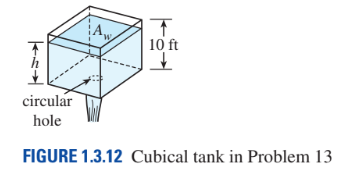
Suppose water is leaking from a tank through a circular hole of area \(A_{h}) at its bottom. When water leaks through a hole, friction and contraction of the stream near the hole reduce the volume of the water leaving the tank per second to \(c A_{h} \sqrt{2 g h}), where c (0 < c < 1) is an empirical constant. Determine a differential equation for the height h of water at time t for the cubical tank in FIGURE 1.3.12. The radius of the hole is 2 in and \(g=32 \mathrm{ft} / \mathrm{s}^{2}\).
Solution
The first step in solving 1.3 problem number 13 trying to solve the problem we have to refer to the textbook question: Suppose water is leaking from a tank through a circular hole of area \(A_{h}) at its bottom. When water leaks through a hole, friction and contraction of the stream near the hole reduce the volume of the water leaving the tank per second to \(c A_{h} \sqrt{2 g h}), where c (0 < c < 1) is an empirical constant. Determine a differential equation for the height h of water at time t for the cubical tank in FIGURE 1.3.12. The radius of the hole is 2 in and \(g=32 \mathrm{ft} / \mathrm{s}^{2}\).
From the textbook chapter Differential Equations as Mathematical Models you will find a few key concepts needed to solve this.
Visible to paid subscribers only
Step 3 of 7)Visible to paid subscribers only
Subscribe to view the
full solution
full solution
Title
Advanced Engineering Mathematics 6
Author
Dennis G. Zill
ISBN
9781284105902
Answer: Suppose water is leaking from a tank through a circular hole of area Ah at its
Chapter 1.3 textbook questions
-
Chapter 1: Problem 1 Advanced Engineering Mathematics 6
-
Chapter 1: Problem 2 Advanced Engineering Mathematics 6
The population model given in (1) fails to take death into consideration; the growth rate equals the birth rate. In another model of a changing population of a community, it is assumed that the rate at which the population changes is a net rate—that is, the difference between the rate of births and the rate of deaths in the community. Determine a model for the population P(t) if both the birth rate and the death rate are proportional to the population present at time t.
Read more -
Chapter 1: Problem 3 Advanced Engineering Mathematics 6
Using the concept of a net rate introduced in Problem 2, determine a differential equation governing a population P(t) if the birth rate is proportional to the population present at time t but the death rate is proportional to the square of the population present at time t.
Read more -
Chapter 1: Problem 4 Advanced Engineering Mathematics 6
Modify the model in Problem 3 for the net rate at which the population P(t) of a certain kind of fish changes by also assuming that the fish are harvested at a constant rate h > 0.
Read more -
Chapter 1: Problem 5 Advanced Engineering Mathematics 6
A cup of coffee cools according to Newton’s law of cooling (3). Use data from the graph of the temperature T(t) in FIGURE 1.3.10 to estimate the constants \(T_{m}, T_{0}\), and k in a model of the form of the first-order initial-value problem \(\frac{d T}{d t}=k\left(T-T_{m}\right)\), \(T(0)=T_{0}\)
Read more -
Chapter 1: Problem 6 Advanced Engineering Mathematics 6
The ambient temperature \(T_{m}\) in (3) could be a function of time t. Suppose that in an artificially controlled environment, \(T_{m}(t)\) is periodic with a 24-hour period, as illustrated in FIGURE 1.3.11. Devise a mathematical model for the temperature T(t) of a body within this environment.
Read more -
Chapter 1: Problem 7 Advanced Engineering Mathematics 6
Suppose a student carrying a flu virus returns to an isolated college campus of 1000 students. Determine a differential equation governing the number of students x(t) who have contracted the flu if the rate at which the disease spreads is proportional to the number of interactions between the number of students with the flu and the number of students who have not yet been exposed to it.
Read more -
Chapter 1: Problem 8 Advanced Engineering Mathematics 6
At a time t = 0, a technological innovation is introduced into a community with a fixed population of n people. Determine a differential equation governing the number of people x(t) who have adopted the innovation at time t if it is assumed that the rate at which the innovation spreads through the community is jointly proportional to the number of people who have adopted it and the number of people who have not adopted it.
Read more -
Chapter 1: Problem 9 Advanced Engineering Mathematics 6
Suppose that a large mixing tank initially holds 300 gallons of water in which 50 pounds of salt has been dissolved. Pure water is pumped into the tank at a rate of 3 gal/min, and when the solution is well stirred, it is pumped out at the same rate. Determine a differential equation for the amount A(t) of salt in the tank at time t. What is A(0)?
Read more -
Chapter 1: Problem 10 Advanced Engineering Mathematics 6
Suppose that a large mixing tank initially holds 300 gallons of water in which 50 pounds of salt has been dissolved. Another brine solution is pumped into the tank at a rate of 3 gal/min, and when the solution is well stirred, it is pumped out at a slower rate of 2 gal/min. If the concentration of the solution entering is 2 lb/gal, determine a differential equation for the amount A(t) of salt in the tank at time t.
Read more -
Chapter 1: Problem 11 Advanced Engineering Mathematics 6
What is the differential equation in Problem 10 if the well-stirred solution is pumped out at a faster rate of 3.5 gal/min?
Read more -
Chapter 1: Problem 12 Advanced Engineering Mathematics 6
Generalize the model given in (8) of this section by assuming that the large tank initially contains \(N_{0}\) number of gallons of brine, \(r_{\text {in }} \text { and } r_{o u t}\) are the input and output rates of the brine, respectively (measured in gallons per minute), \(\boldsymbol{C}_{\text {in }}\) is the concentration of the salt in the inflow, c(t) is the concentration of the salt in the tank as well as in the outflow at time t (measured in pounds of salt per gallon), and A(t) is the amount of salt in the tank at time t.
Read more -
Chapter 1: Problem 13 Advanced Engineering Mathematics 6
Suppose water is leaking from a tank through a circular hole of area \(A_{h}) at its bottom. When water leaks through a hole, friction and contraction of the stream near the hole reduce the volume of the water leaving the tank per second to \(c A_{h} \sqrt{2 g h}), where c (0 < c < 1) is an empirical constant. Determine a differential equation for the height h of water at time t for the cubical tank in FIGURE 1.3.12. The radius of the hole is 2 in and \(g=32 \mathrm{ft} / \mathrm{s}^{2}\).
Read more -
Chapter 1: Problem 14 Advanced Engineering Mathematics 6
The right-circular conical tank shown in FIGURE 1.3.13 loses water out of a circular hole at its bottom. Determine a differential equation for the height of the water h at time t. The radius of the hole is 2 in, \(g=32 \mathrm{ft} / \mathrm{s}^{2}\), and the friction/contraction factor introduced in Problem 13 is c = 0.6.
Read more -
Chapter 1: Problem 15 Advanced Engineering Mathematics 6
A series circuit contains a resistor and an inductor as shown in FIGURE 1.3.14. Determine a differential equation for the current i(t) if the resistance is R, the inductance is L, and the impressed voltage is E(t).
Read more -
Chapter 1: Problem 16 Advanced Engineering Mathematics 6
A series circuit contains a resistor and a capacitor as shown in FIGURE 1.3.15. Determine a differential equation for the charge q(t) on the capacitor if the resistance is R, the capacitance is C, and the impressed voltage is E(t).
Read more -
Chapter 1: Problem 17 Advanced Engineering Mathematics 6
For high-speed motion through the air—such as the skydiver shown in FIGURE 1.3.16 falling before the parachute is opened— air resistance is closer to a power of the instantaneous velocity v(t). Determine a differential equation for the velocity v(t) of a falling body of mass m if air resistance is proportional to the square of the instantaneous velocity.
Read more -
Chapter 1: Problem 18 Advanced Engineering Mathematics 6
A cylindrical barrel s ft in diameter of weight w lb is floating in water as shown in FIGURE 1.3.17(a). After an initial depression, the barrel exhibits an up-and-down bobbing motion along a vertical line. Using Figure 1.3.17(b), determine a differential equation for the vertical displacement y(t) if the origin is taken to be on the vertical axis at the surface of the water when the barrel is at rest. Use Archimedes’ principle: Buoyancy, or upward force of the water on the barrel, is equal to the weight of the water displaced. Assume that the downward direction is positive, that the weight density of water is \(62.4 \mathrm{lb} / \mathrm{ft}^{3}\), and that there is no resistance between the barrel and the water.
Read more -
Chapter 1: Problem 19 Advanced Engineering Mathematics 6
After a mass m is attached to a spring, it stretches s units and then hangs at rest in the equilibrium position as shown in FIGURE 1.3.18(b). After the spring/mass system has been set in motion, let x(t) denote the directed distance of the mass beyond the equilibrium position. As indicated in Figure 1.3.18(c), assume that the downward direction is positive, that the motion takes place in a vertical straight line through the center of gravity of the mass, and that the only forces acting on the system are the weight of the mass and the restoring force of the stretched spring. Use Hooke’s law: The restoring force of a spring is proportional to its total elongation. Determine a differential equation for the displacement x(t) at time t.
Read more -
Chapter 1: Problem 20 Advanced Engineering Mathematics 6
In Problem 19, what is a differential equation for the displacement x(t) if the motion takes place in a medium that imparts a damping force on the spring/mass system that is proportional to the instantaneous velocity of the mass and acts in a direction opposite to that of motion?
Read more -
Chapter 1: Problem 21 Advanced Engineering Mathematics 6
When the mass m of a body moving through a force field is variable, Newton’s second law of motion takes on the form: If the net force acting on a body is not zero, then the net force F is equal to the time rate of change of momentum of the body. That is, \(F=\frac{d}{d t}(m v)\), where mv is momentum. Use this formulation of Newton’s second law in Problems 21 and 22. *Note that when m is constant, this is the same as F = ma. Consider a single-stage rocket that is launched vertically upward as shown in the accompanying photo. Let m(t) denote the total mass of the rocket at time t (which is the sum of three masses: the constant mass of the payload, the constant mass of the vehicle, and the variable amount of fuel). Assume that the positive direction is upward, air resistance is proportional to the instantaneous velocity v of the rocket, and R is the upward thrust or force generated by the propulsion system. Use (17) to find a mathematical model for the velocity v(t) of the rocket.
Read more -
Chapter 1: Problem 22 Advanced Engineering Mathematics 6
When the mass m of a body moving through a force field is variable, Newton’s second law of motion takes on the form: If the net force acting on a body is not zero, then the net force F is equal to the time rate of change of momentum of the body. That is, \(F=\frac{d}{d t}(m v)\), where mv is momentum. Use this formulation of Newton’s second law in Problems 21 and 22. *Note that when m is constant, this is the same as F = ma. In Problem 21, suppose \(m(t)=m_{p}+m_{v}+m_{f}(t)\) where \(m_{p}\) is constant mass of the payload, \(m_{pv}\) is the constant mass of the vehicle, and \(m_{f}(t)\) is the variable amount of fuel. (a) Show that the rate at which the total mass of the rocket changes is the same as the rate at which the mass of the fuel changes. (b) If the rocket consumes its fuel at a constant rate \(\lambda\), find m(t). Then rewrite the differential equation in Problem 21 in terms of l and the initial total mass \(m(0)=m_{0}\). (c) Under the assumption in part (b), show that the burnout time \(t_{b}>0\) of the rocket, or the time at which all the fuel is consumed, is \(t_{b}=m_{f}(0) / \lambda\), where \(m_{f}(0)\) is the initial mass of the fuel.
Read more -
Chapter 1: Problem 23 Advanced Engineering Mathematics 6
By Newton’s law of universal gravitation, the free-fall acceleration a of a body, such as the satellite shown in FIGURE 1.3.19, falling a great distance to the surface is not the constant g. Rather, the acceleration a is inversely proportional to the square of the distance from the center of the Earth, \(a=k / r^{2}\), where k is the constant of proportionality. Use the fact that at the surface of the Earth r = R and a = g to determine k. If the positive direction is upward, use Newton’s second law and his universal law of gravitation to find a differential equation for the distance r.
Read more -
Chapter 1: Problem 24 Advanced Engineering Mathematics 6
Suppose a hole is drilled through the center of the Earth and a bowling ball of mass m is dropped into the hole, as shown in FIGURE 1.3.20. Construct a mathematical model that describes the motion of the ball. At time t let r denote the distance from the center of the Earth to the mass m, M denote the mass of the Earth, \(M_{r}\) denote the mass of that portion of the Earth within a sphere of radius r, and \(\delta\) denote the constant density of the Earth.
Read more -
Chapter 1: Problem 25 Advanced Engineering Mathematics 6
Learning Theory In the theory of learning, the rate at which a subject is memorized is assumed to be proportional to the amount that is left to be memorized. Suppose M denotes the total amount of a subject to be memorized and A(t) is the amount memorized in time t. Determine a differential equation for the amount A(t).
Read more -
Chapter 1: Problem 26 Advanced Engineering Mathematics 6
Forgetfulness In Problem 25, assume that the rate at which material is forgotten is proportional to the amount memorized in time t. Determine a differential equation for A(t) when forgetfulness is taken into account.
Read more -
Chapter 1: Problem 27 Advanced Engineering Mathematics 6
Infusion of a Drug A drug is infused into a patient’s bloodstream at a constant rate of r grams per second. Simultaneously, the drug is removed at a rate proportional to the amount x(t) of the drug present at time t. Determine a differential equation governing the amount x(t).
Read more -
Chapter 1: Problem 28 Advanced Engineering Mathematics 6
Tractrix A motorboat starts at the origin and moves in the direction of the positive x-axis, pulling a waterskier along a curve C called a tractrix. See FIGURE 1.3.21. The waterskier, initially located on the y-axis at the point (0, s), is pulled by keeping a rope of constant length s, which is kept taut throughout the motion. At time t > 0 the waterskier is at the point P(x, y). Find the differential equation of the path of motion C.
Read more -
Chapter 1: Problem 29 Advanced Engineering Mathematics 6
Reflecting Surface Assume that when the plane curve C shown in FIGURE 1.3.22 is revolved about the x-axis it generates a surface of revolution with the property that all light rays L parallel to the x-axis striking the surface are reflected to a single point O (the origin). Use the fact that the angle of incidence is equal to the angle of reflection to determine a differential equation that describes the shape of the curve C. Such a curve C is important in applications ranging from construction of telescopes to satellite antennas, automobile headlights, and solar collectors. [Hint: Inspection of the figure shows that we can write \(\phi=2 \theta\). Why? Now use an appropriate trigonometric identity.]
Read more -
Chapter 1: Problem 30 Advanced Engineering Mathematics 6
Reread Problem 45 in Exercises 1.1 and then give an explicit solution P(t) for equation (1). Find a one-parameter family of solutions of (1).
Read more -
Chapter 1: Problem 31 Advanced Engineering Mathematics 6
Reread the sentence following equation (3) and assume that \(T_{m}\) is a positive constant. Discuss why we would expect k < 0 in (3) in both cases of cooling and warming. You might start by interpreting, say, \(T(t)>T_{m}\) in a graphical manner.
Read more -
Chapter 1: Problem 32 Advanced Engineering Mathematics 6
Reread the discussion leading up to equation (8). If we assume that initially the tank holds, say, 50 lbs of salt, it stands to reason that since salt is being added to the tank continuously for t > 0, that A(t) should be an increasing function. Discuss how you might determine from the DE, without actually solving it, the number of pounds of salt in the tank after a long period of time.
Read more -
Chapter 1: Problem 33 Advanced Engineering Mathematics 6
Population Model The differential equation dP/dt (k cos t)P, where k is a positive constant, is a model of human population P(t) of a certain community. Discuss an interpretation for the solution of this equation; in other words, what kind of population do you think the differential equation describes?
Read more -
Chapter 1: Problem 34 Advanced Engineering Mathematics 6
Rotating Fluid As shown in FIGURE 1.3.23(a), a right-circular cylinder partially filled with fluid is rotated with a constant angular velocity \(\omega\) about a vertical y-axis through its center. The rotating fluid is a surface of revolution S. To identify S we first establish a coordinate system consisting of a vertical plane determined by the y-axis and an x-axis drawn perpendicular to the y-axis such that the point of intersection of the axes (the origin) is located at the lowest point on the surface S. We then seek a function y = f (x), which represents the curve C of intersection of the surface S and the vertical coordinate plane. Let the point P(x, y) denote the position of a particle of the rotating fluid of mass m in the coordinate plane. See Figure 1.3.23(b). (a) At P, there is a reaction force of magnitude F due to the other particles of the fluid, which is normal to the surface S. By Newton’s second law the magnitude of the net force acting on the particle is \(m \omega^{2} x\). What is this force? Use Figure 1.3.23(b) to discuss the nature and origin of the equations \(F \cos \theta=m g\), \(F \sin \theta=m \omega^{2} x\). (b) Use part (a) to find a first-order differential equation that defines the function y = f (x).
Read more -
Chapter 1: Problem 35 Advanced Engineering Mathematics 6
Falling Body In Problem 23, suppose r = R + s, where s is the distance from the surface of the Earth to the falling body. What does the differential equation obtained in Problem 23 become when s is very small compared to R?
Read more -
Chapter 1: Problem 36 Advanced Engineering Mathematics 6
Raindrops Keep Falling In meteorology, the term virga refers to falling raindrops or ice particles that evaporate before they reach the ground. Assume that a typical raindrop is spherical in shape. Starting at some time, which we can designate as t = 0, the raindrop of radius \(r_{0}\) falls from rest from a cloud and begins to evaporate. (a) If it is assumed that a raindrop evaporates in such a manner that its shape remains spherical, then it also makes sense to assume that the rate at which the raindrop evaporates—that is, the rate at which it loses mass—is proportional to its surface area. Show that this latter assumption implies that the rate at which the radius r of the raindrop decreases is a constant. Find r(t). [Hint: See Problem 55 in Exercises 1.1.] (b) If the positive direction is downward, construct a mathematical model for the velocity v of the falling raindrop at time t. Ignore air resistance. [Hint: Use the form of Newton’s second law as given in (17).]
Read more -
Chapter 1: Problem 37 Advanced Engineering Mathematics 6
Let It Snow The “snowplow problem” is a classic and appears in many differential equations texts but was probably made famous by Ralph Palmer Agnew: “One day it started snowing at a heavy and steady rate. A snowplow started out at noon, going 2 miles the first hour and 1 mile the second hour. What time did it start snowing?” If possible, find the text Differential Equations, Ralph Palmer Agnew, McGraw-Hill, and then discuss the construction and solution of the mathematical model.
Read more -
Chapter 1: Problem 38 Advanced Engineering Mathematics 6
Reread this section and classify each mathematical model as linear or nonlinear.
Read more -
Chapter 1: Problem 39 Advanced Engineering Mathematics 6
Population Dynamics Suppose that \(P^{\prime}(t)=0.15 P(t)\) represents a mathematical model for the growth of a certain cell culture, where P(t) is the size of the culture (measured in millions of cells) at time t (measured in hours). How fast is the culture growing at the time t when the size of the culture reaches 2 million cells?
Read more -
Chapter 1: Problem 40 Advanced Engineering Mathematics 6
Radioactive Decay Suppose that \(A^{\prime}(t)=-0.0004332 A(t)\) represents a mathematical model for the decay of radium-226, where A(t) is the amount of radium (measured in grams) remaining at time t (measured in years). How much of the radium sample remains at time t when the sample is decaying at a rate of 0.002 grams per year?
Read more