
Testing for Exactness In Exercises 1-4, determine whether the differential equation is exact. Explain your reasoning. \(\left(2 x+x y^{2}\right) d x+\left(3+x^{2} y\right) d y=0\) Text Transcription: (2x+xy^2)dx + (3+x^2y) dy=0
Read moreTable of Contents
C.1
Real Numbers and the Real Number Line
C.2
The Cartesian Plane
C.3
Review of Trigonometric Functions
1
Preparation for Calculus
1.1
Graphs and Models
1.2
Linear Models and Rates of Change
1.3
Functions and Their Graphs
1.4
Fitting Models to Data
1.5
Inverse Functions
1.6
Exponential and Logarithmic Functions
2
Limits and Their Properties
2.1
A Preview of Calculus
2.2
Finding Limits Graphically and Numerically
2.3
Evaluating Limits Analytically
2.4
Continuity and One-Sided Limits
2.5
Infinite Limits
3
Differentiation
3.1
The Derivative and the Tangent Line Problem
3.2
Basic Differentiation Rules and Rates of Change
3.3
Product and Quotient Rules and Higher-Order Derivatives
3.4
The Chain Rule
3.5
Implicit Differentiation
3.6
Derivatives of Inverse Functions
3.7
Related Rates
3.8
Newtons Method
4
Applications of Differentiation
4.1
Extrema on an Interval
4.2
Rolles Theorem and the Mean Value Theorem
4.3
Increasing and Decreasing Functions and the First DerivativeTest
4.4
Concavity and the Second Derivative Test
4.5
Limits at Infinity
4.6
A Summary of Curve Sketching
4.7
Optimization Problems
4.8
Differentials
5
Integration
5.1
Antiderivatives and Indefinite Integration
5.2
Area
5.3
Riemann Sums and Definite Integrals
5.4
The Fundamental Theorem of Calculus
5.5
Integration by Substitution
5.6
Numerical Integration
5.7
The Natural Logarithmic Function: Integration
5.8
Inverse Trigonometric Functions: Integration
5.9
Hyperbolic Functions
6
Differential Equations
6.1
Slope Fields and Euler's Method
6.2
Differential Equations: Growth and Decay
6.3
Differential Equations: Separation of Variables
6.4
The Logistic Equation
6.5
First-Order Linear Differential Equations
6.6
Predator-Prey Differential Equations
7
Applications of Integration
7.1
Area of a Region Between Two Curves
7.2
Volume:The Disk Method
7.3
Volume: The Shell Method
7.4
Arc Length and Surfaces of Revolution
7.5
Work
7.6
Moments, Centers of Mass, and Centroids
7.7
Fluid Pressure and Fluid Force
8
Integration Techniques, L'Hopital's Rule, and Improper Integrals
8.1
Basic Integration Rules
8.2
Integration by Parts
8.3
Trigonometric Integrals
8.4
Trigonometric Substitution
8.5
Partial Fractions
8.6
Integration by Tables and Other Integration Techniques
8.7
Indeterminate Forms and L'Hopital's Rule
8.8
Improper Integrals
9
Infinite Series
9.1
Sequences
9.10
Taylor and Maclaurin Series
9.2
Series and Convergence
9.3
The Integral Test and p-Series
9.4
Comparisons of Series
9.5
Alternating Series
9.6
The Ratio and Root Tests
9.7
Taylor Polynomials and Approximations
9.8
Power Series
9.9
Representation of Functions by Power Series
10
Conics, Parametric Equations, and Polar Coordinates
10.1
Conics and Calculus
10.2
Plane Curves and Parametric Equations
10.3
Parametric Equations and Calculus
10.4
Polar Coordinates and Polar Graphs
10.5
Area and Arc Length in Polar Coordinates
10.6
Polar Equations of Conics and Kepler's Laws
11
Vectors and the Geometry of Space
11.1
Vectors in the Plane
11.2
Space Coordinates and Vectors in Space
11.3
The Dot Product of Two Vectors
11.4
The Cross Product of Two Vectors in Space
11.5
Lines and Planes in Space
11.6
Surfaces in Space
11.7
Cylindrical and Spherical Coordinates
12
Vector-Valued Functions
12.1
Vector-Valued Functions
12.2
Differentiation and Integration of Vector-Valued Functions
12.3
Velocity and Acceleration
12.4
Tangent Vectors and Normal Vectors
12.5
Arc Length and Curvature
13
Functions of Several Variables
13.1
Introduction to Functions of Several Variables
13.10
Lagrange Multipliers
13.2
Limits and Continuity
13.3
Partial Derivatives
13.4
Differentials
13.5
Chain Rules for Functions of Several Variables
13.6
Directional Derivatives and Gradients
13.7
Tangent Planes and Normal Lines
13.8
Extrema of Functions of Two Variables
13.9
Applications of Extrema
14
Multiple Integration
14.1
Iterated Integrals and Area in the Plane
14.2
Double Integrals and Volume
14.3
Change of Variables: Polar Coordinates
14.4
Center of Mass and Moments of Inertia
14.5
Surface Area
14.6
Triple Integrals and Applications
14.7
Triple Integrals in Other Coordinates
14.8
Change of Variables: Jacobians
15
Vector Analysis
15.1
Vector Fields
15.2
Line Integrals
15.3
Conservative Vector Fields and Independence of Path
15.4
Green's Theorem
15.5
Parametric Surfaces
15.6
Surface Integrals
15.7
Divergence Theorem
15.8
Stokes's Theorem
16
Additional Topics in Differential Equations
16.1
Exact First-Order Equations
16.2
Second-Order Homogeneous Linear Equations
16.3
Second-Order Nonhomogeneous Linear Equations
16.4
Series Solutions of Differential Equations
Textbook Solutions for Calculus: Early Transcendental Functions
Chapter 16.1 Problem 15
Question
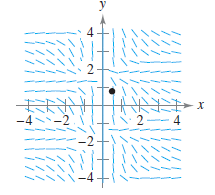
Graphical and Analytic Analysis In Exercises 15 and 16, (a) sketch an approximate solution of the differential equation satisfying the initial condition on the slope field, (b) find the particular solution that satisfies the initial condition, and (c) use a graphing utility to graph the particular solution. Compare the graph with the sketch in part (a).
Differential Equation Initial Condition
\((2 x \tan y+5) d x+\left(x^{2} \sec ^{2} y\right) d y=0 \quad\left(\frac{1}{2}, \frac{\pi}{4}\right)\)
Text Transcription:
(2x tan y+5)dx + (x^2 sec^2 y)dy=0 (1/2, pi/4)
Solution
The first step in solving 16.1 problem number 15 trying to solve the problem we have to refer to the textbook question: Graphical and Analytic Analysis In Exercises 15 and 16, (a) sketch an approximate solution of the differential equation satisfying the initial condition on the slope field, (b) find the particular solution that satisfies the initial condition, and (c) use a graphing utility to graph the particular solution. Compare the graph with the sketch in part (a).Differential Equation Initial Condition\((2 x \tan y+5) d x+\left(x^{2} \sec ^{2} y\right) d y=0 \quad\left(\frac{1}{2}, \frac{\pi}{4}\right)\)Text Transcription:(2x tan y+5)dx + (x^2 sec^2 y)dy=0 (1/2, pi/4)
From the textbook chapter Exact First-Order Equations you will find a few key concepts needed to solve this.
Visible to paid subscribers only
Step 3 of 7)Visible to paid subscribers only
Subscribe to view the
full solution
full solution
Title
Calculus: Early Transcendental Functions 6
Author
Ron Larson
ISBN
9781285774770
Graphical and Analytic Analysis In Exercises 15 and 16, (a) sketch an approximate
Chapter 16.1 textbook questions
-
Chapter 16: Problem 1 Calculus: Early Transcendental Functions 6
-
Chapter 16: Problem 2 Calculus: Early Transcendental Functions 6
Testing for Exactness In Exercises 1-4, determine whether the differential equation is exact. Explain your reasoning. \((1-x y) d x+(y-x y) d y=0\) Text Transcription: (1-x y) d x+(y-x y) d y=0
Read more -
Chapter 16: Problem 3 Calculus: Early Transcendental Functions 6
Testing for Exactness In Exercises 1-4, determine whether the differential equation is exact. Explain your reasoning. \(x \sin y \ d x+x \cos y \ d y=0\) Text Transcription: x sin y dx+x cos y dy=0
Read more -
Chapter 16: Problem 4 Calculus: Early Transcendental Functions 6
Testing for Exactness In Exercises 1-4, determine whether the differential equation is exact. Explain your reasoning. \(y e^{x y} d x+x e^{x y} d y=0\) Text Transcription: y e^xy dx+x e^xy dy=0
Read more -
Chapter 16: Problem 5 Calculus: Early Transcendental Functions 6
Solving an Exact Differential Equation In Exercises 5-14, determine whether the differential equation is exact. If it is,find the general solution. \((2 x-3 y) d x+(2 y-3 x) d y=0\) Text Transcription: (2x-3y) dx+(2y-3x) dy=0
Read more -
Chapter 16: Problem 6 Calculus: Early Transcendental Functions 6
Solving an Exact Differential Equation In Exercises 5-14, determine whether the differential equation is exact. If it is,find the general solution. \(y e^{x} d x+e^{x} d y=0\) Text Transcription: y e^x dx+e^x dy=0
Read more -
Chapter 16: Problem 7 Calculus: Early Transcendental Functions 6
Solving an Exact Differential Equation In Exercises 5-14, determine whether the differential equation is exact. If it is,find the general solution. \(\left(3 y^{2}+10 x y^{2}\right) d x+\left(6 x y-2+10 x^{2} y\right) d y=0\) Text Transcription: (3x^2+10xy^2)dx+(6xy-2+10x^2y)dy=0
Read more -
Chapter 16: Problem 8 Calculus: Early Transcendental Functions 6
Solving an Exact Differential Equation In Exercises 5-14, determine whether the differential equation is exact. If it is,find the general solution. \(2 \cos (2 x-y) d x-\cos (2 x-y) d y=0\) Text Transcription: 2 cos (2 x-y) dx-cos (2x-y) dy=0
Read more -
Chapter 16: Problem 9 Calculus: Early Transcendental Functions 6
Solving an Exact Differential Equation In Exercises 5-14, determine whether the differential equation is exact. If it is,find the general solution. \(\left(4 x^{3}-6 x y^{2}\right) d x+\left(4 y^{3}-6 x y\right) d y=0\) Text Transcription: (4x^3-6xy^2)dx+(4y^3-6xy)dy=0
Read more -
Chapter 16: Problem 10 Calculus: Early Transcendental Functions 6
Solving an Exact Differential Equation In Exercises 5-14, determine whether the differential equation is exact. If it is,find the general solution. \(2 y^{2} e^{x y^{2}} d x+2 x y e^{x y^{2}} d y=0\) Text Transcription: 2y^2 e^xy^2 dx + 2xye^xy^2 dy=0
Read more -
Chapter 16: Problem 11 Calculus: Early Transcendental Functions 6
Solving an Exact Differential Equation In Exercises 5-14, determine whether the differential equation is exact. If it is,find the general solution. \(\frac{1}{x^{2}+y^{2}}(x d y-y d x)=0\) Text Transcription: 1/x^2+y^2 (x dy-y dx)=0
Read more -
Chapter 16: Problem 12 Calculus: Early Transcendental Functions 6
Solving an Exact Differential Equation In Exercises 5-14, determine whether the differential equation is exact. If it is,find the general solution. \(e^{-\left(x^{2}+y^{2}\right)}(x d x+y d y)=0\) Text Transcription: e^y cos xy [y dx] + (tan xy) dy]=0
Read more -
Chapter 16: Problem 13 Calculus: Early Transcendental Functions 6
Solving an Exact Differential Equation In Exercises 5-14, determine whether the differential equation is exact. If it is,find the general solution. \(\frac{1}{(x-y)^{2}}\left(y^{2} d x+x^{2} d y\right)=0\) Text Transcription: 1/(x-y)^2 (y^2 dx+x^2 dy)=0
Read more -
Chapter 16: Problem 14 Calculus: Early Transcendental Functions 6
Solving an Exact Differential Equation In Exercises 5-14, determine whether the differential equation is exact. If it is,find the general solution. \(e^{y} \cos x y[y \ d x+(x+\tan x y) d y]=0\) Text Transcription: e^y cos x y[y d x+(x+tan x y) dy]=0
Read more -
Chapter 16: Problem 15 Calculus: Early Transcendental Functions 6
Graphical and Analytic Analysis In Exercises 15 and 16, (a) sketch an approximate solution of the differential equation satisfying the initial condition on the slope field, (b) find the particular solution that satisfies the initial condition, and (c) use a graphing utility to graph the particular solution. Compare the graph with the sketch in part (a). Differential Equation Initial Condition \((2 x \tan y+5) d x+\left(x^{2} \sec ^{2} y\right) d y=0 \quad\left(\frac{1}{2}, \frac{\pi}{4}\right)\) Text Transcription: (2x tan y+5)dx + (x^2 sec^2 y)dy=0 (1/2, pi/4)
Read more -
Chapter 16: Problem 16 Calculus: Early Transcendental Functions 6
Graphical and Analytic Analysis In Exercises 15 and 16, (a) sketch an approximate solution of the differential equation satisfying the initial condition on the slope field, (b) find the particular solution that satisfies the initial condition, and (c) use a graphing utility to graph the particular solution. Compare the graph with the sketch in part (a). Differential Equation Initial Condition \(\frac{1}{\sqrt{x^{2}+y^{2}}}(x d x+y d y)=0 \quad (4,3)\) Text Transcription: 1/sqrt x^2+y^2 (x dx+y dy)=0
Read more -
Chapter 16: Problem 17 Calculus: Early Transcendental Functions 6
Finding a Particular Solution In Exercises 17-22,find the particular solution that satisfies the initial condition. Differential Equation Initial Condition \(\frac{y}{x-1} d x+[\ln (x-1)+2 y] d y=0\) y(2) = 4 Text Transcription: y/x-1 dx + [ln(x-1) + 2y]dy = 0
Read more -
Chapter 16: Problem 18 Calculus: Early Transcendental Functions 6
Finding a Particular Solution In Exercises 17-22,find the particular solution that satisfies the initial condition. Differential Equation Initial Condition \(\frac{1}{x^{2}+y^{2}}(x d x+y d y)=0\) y(2) = 4 Text Transcription: 1/x^2+y^2 (x dx + y dy) = 0
Read more -
Chapter 16: Problem 19 Calculus: Early Transcendental Functions 6
Finding a Particular Solution In Exercises 17-22,find the particular solution that satisfies the initial condition. Differential Equation Initial Condition \(e^{3 x}(\sin 3 y d x+\cos 3 y d y)=0\) y(2) = \(\pi\) Text Transcription: e^3x(sin 3y dx + cos 3y dy) = 0 pi
Read more -
Chapter 16: Problem 20 Calculus: Early Transcendental Functions 6
Finding a Particular Solution In Exercises 17-22,find the particular solution that satisfies the initial condition. Differential Equation Initial Condition \(\left(x^{2}+y^{2}\right) d x+2 x y \ d y=0\) y(3) = 1 Text Transcription: (x^2+y^2)dx+2xy dy=0
Read more -
Chapter 16: Problem 21 Calculus: Early Transcendental Functions 6
Finding a Particular Solution In Exercises 17-22,find the particular solution that satisfies the initial condition. Differential Equation Initial Condition \(\left(2 x y-9 x^{2}\right) d x+\left(2 y+x^{2}+1\right) d y=0\) y(0) = -3 Text Transcription: (2xy-9x^2)dx+(2y+x^2+1)dy=0
Read more -
Chapter 16: Problem 22 Calculus: Early Transcendental Functions 6
Finding a Particular Solution In Exercises 17-22,find the particular solution that satisfies the initial condition. Differential Equation Initial Condition \(\left(2 x y^{2}+4\right) d x+\left(2 x^{2} y-6\right) d y=0\) y(-1) = 8 Text Transcription: (2xy^2+4)dx+(2x^2y-6)dy=0
Read more -
Chapter 16: Problem 23 Calculus: Early Transcendental Functions 6
Finding an Integrating Factor In Exercises 23-32,find the integrating factor that is a function of x or y alone and use it to find the general solution of the differential equation. \(y \ d x-\left(x+6 y^{2}\right) d y=0\) Text Transcription: y dx-(x+6y^2)dy=0
Read more -
Chapter 16: Problem 24 Calculus: Early Transcendental Functions 6
Finding an Integrating Factor In Exercises 23-32,find the integrating factor that is a function of x or y alone and use it to find the general solution of the differential equation. \(\left(2 x^{3}+y\right) d x-x \ d y=0\) Text Transcription: (2x^3+y)dx-x dy=0
Read more -
Chapter 16: Problem 25 Calculus: Early Transcendental Functions 6
Finding an Integrating Factor In Exercises 23-32,find the integrating factor that is a function of x or y alone and use it to find the general solution of the differential equation. \(\left(5 x^{2}-y\right) d x+x \ d y=0\) Text Transcription: (5x^2-y)dx+x dy=0
Read more -
Chapter 16: Problem 26 Calculus: Early Transcendental Functions 6
Finding an Integrating Factor In Exercises 23-32,find the integrating factor that is a function of x or y alone and use it to find the general solution of the differential equation. \(\left(5 x^{2}-y^{2}\right) d x+2 y d y=0\) Text Transcription: (5x^2-y^2)dx+2ydy=0
Read more -
Chapter 16: Problem 27 Calculus: Early Transcendental Functions 6
Finding an Integrating Factor In Exercises 23-32,find the integrating factor that is a function of x or y alone and use it to find the general solution of the differential equation. \((x+y) d x+\tan x d y=0\) Text Transcription: (x+y) d x+\tan x dy=0
Read more -
Chapter 16: Problem 28 Calculus: Early Transcendental Functions 6
Finding an Integrating Factor In Exercises 23-32,find the integrating factor that is a function of x or y alone and use it to find the general solution of the differential equation. \(\left(2 x^{2} y-1\right) d x+x^{3} d y=0\) Text Transcription: (2 x^2 y-1) dx+x^3 dy=0
Read more -
Chapter 16: Problem 29 Calculus: Early Transcendental Functions 6
Finding an Integrating Factor In Exercises 23-32,find the integrating factor that is a function of x or y alone and use it to find the general solution of the differential equation. \(y^{2} d x+(x y-1) d y=0\) Text Transcription: y^2 dx+(x y-1) dy=0
Read more -
Chapter 16: Problem 30 Calculus: Early Transcendental Functions 6
Finding an Integrating Factor In Exercises 23-32,find the integrating factor that is a function of x or y alone and use it to find the general solution of the differential equation. \(\left(x^{2}+2 x+y\right) d x+2 d y=0\) Text Transcription: (x^2+2x+y)dx+2dy=0
Read more -
Chapter 16: Problem 31 Calculus: Early Transcendental Functions 6
Finding an Integrating Factor In Exercises 23-32,find the integrating factor that is a function of x or y alone and use it to find the general solution of the differential equation. \(2 y d x+(x-\sin \sqrt{y}) d y=0\) Text Transcription: 2ydx+(x-sin sqrt y)dy=0
Read more -
Chapter 16: Problem 32 Calculus: Early Transcendental Functions 6
Finding an Integrating Factor In Exercises 23-32,find the integrating factor that is a function of x or y alone and use it to find the general solution of the differential equation. \(\left(-2 y^{3}+1\right) d x+\left(3 x y^{2}+x^{3}\right) d y=0\) Text Transcription: (-2y^3+1)dx+(3xy^2+x^3)dy=0
Read more -
Chapter 16: Problem 33 Calculus: Early Transcendental Functions 6
Using an Integrating Factor In Exercises 33-36, use the integrating factor to find the general solution of the differential equation. Integrating Factor Differential Equation \(u(x, y)=x y^{2}\) \(\left(4 x^{2} y+2 y^{2}\right) d x+\left(3 x^{3}+4 x y\right) d y=0\) Text Transcription: u(x, y)=x y^2 (4x^2y+2y^2)dx+(3x^3+4xy)dy=0
Read more -
Chapter 16: Problem 34 Calculus: Early Transcendental Functions 6
Using an Integrating Factor In Exercises 33-36, use the integrating factor to find the general solution of the differential equation. Integrating Factor Differential Equation \(u(x, y)=x^{2} y\) \(\left(3 y^{2}+5 x^{2} y\right) d x+\left(3 x y+2 x^{3}\right) d y=0\) Text Transcription: u(x, y)=x^2 y (3y^2+5x^2y)dy+(3xy+2x^3)dy=0
Read more -
Chapter 16: Problem 35 Calculus: Early Transcendental Functions 6
Using an Integrating Factor In Exercises 33-36, use the integrating factor to find the general solution of the differential equation. Integrating Factor Differential Equation \(u(x, y)=x^{-2} y^{-3}\) \(\left(-y^{5}+x^{2} y\right) d x+\left(2 x y^{4}-2 x^{3}\right) d y=0\) Text Transcription: u(x, y)=x^-2 y^-3 (-y^5+x^2y)dx+(2xy^4-2x^3)dy=0
Read more -
Chapter 16: Problem 36 Calculus: Early Transcendental Functions 6
Using an Integrating Factor In Exercises 33-36, use the integrating factor to find the general solution of the differential equation. Integrating Factor Differential Equation \(u(x, y)=x^{-2} y^{-2}\) \(-y^{3} d x+\left(x y^{2}-x^{2}\right)d y=0\) Text Transcription: u(x, y)=x^-2 y^-2 -y^3 dx+(xy^2-x^2)dy=0
Read more -
Chapter 16: Problem 37 Calculus: Early Transcendental Functions 6
Integrating Factor Show that each expression is an integrating factor for the differential equation ydx - xdy = 0. (a) \(\frac{1}{x^{2}}\) (b) \(\frac{1}{y^{2}}\) (c) \(\frac{1}{x y}\) (d) \(\frac{1}{x^{2}+y^{2}}\) Text Transcription: 1/x^2 1/y^2 1/xy 1/x^2+y^2
Read more -
Chapter 16: Problem 38 Calculus: Early Transcendental Functions 6
Integrating Factor Show that the differential equation \(\left(a x y^{2}+b y\right) d x+\left(b x^{2} y+a x\right) d y=0\) is exact only when a = b. For \(a \neq b\), show that \(x^{m} y^{n}\) is an integrating factor, where \(m=-\frac{2 b+a}{a+b}, \quad n=-\frac{2 a+b}{a+b}\). Text Transcription: (axy^2+by)dx+(bx^2y+ax)dy=0 a neq b x^m y^n m=-2b+a/a+b, n=-2a+b/a+b
Read more -
Chapter 16: Problem 39 Calculus: Early Transcendental Functions 6
Tangent Curves In Exercises 39-42,use a graphing utility to graph the family of curves tangent to the force field. \(\mathbf{F}(x, y)=\frac{y}{\sqrt{x^{2}+y^{2}}} \mathbf{i}-\frac{x}{\sqrt{x^{2}+y^{2}}} \mathbf{j}\) Text Transcription: F(x,y)=y/sqrt x^2+y^2 i - x/sqrt x^2+y^2 j
Read more -
Chapter 16: Problem 40 Calculus: Early Transcendental Functions 6
Tangent Curves In Exercises 39-42,use a graphing utility to graph the family of curves tangent to the force field. \(\mathbf{F}(x, y)=\frac{x}{\sqrt{x^{2}+y^{2}}} \mathbf{i}-\frac{y}{\sqrt{x^{2}+y^{2}}} \mathbf{j}\) Text Transcription: F(x,y)=x/sqrt x^2+y^2 i - y/x^2+y^2 j
Read more -
Chapter 16: Problem 41 Calculus: Early Transcendental Functions 6
Tangent Curves In Exercises 39-42,use a graphing utility to graph the family of curves tangent to the force field. \(\mathbf{F}(x, y)=4 x^{2} y \mathbf{i}-\left(2 x y^{2}+\frac{x}{y^{2}}\right) \mathbf{j}\) Text Transcription: F(x,y)=4x^2yi-(2xy^2+x/y^2)j
Read more -
Chapter 16: Problem 42 Calculus: Early Transcendental Functions 6
Tangent Curves In Exercises 39-42,use a graphing utility to graph the family of curves tangent to the force field. \(\mathbf{F}(x, y)=\left(1+x^{2}\right) \mathbf{i}-2 x y \mathbf{j}\) Text Transcription: F(x,y)=(1+x^2)i-2xyj
Read more -
Chapter 16: Problem 43 Calculus: Early Transcendental Functions 6
Finding an Equation of a Curve In Exercises 43 and 44, find an equation of the curve with the specified slope passing through the given point. Slope Point \(\frac{d y}{d x}=\frac{y-x}{3 y-x}\) (2, 1) Text Transcription: dy/dx=y-x/3yx
Read more -
Chapter 16: Problem 44 Calculus: Early Transcendental Functions 6
Finding an Equation of a Curve In Exercises 43 and 44, find an equation of the curve with the specified slope passing through the given point. Slope Point \(\frac{d y}{d x}=\frac{-2 x y}{x^{2}+y^{2}}\) (0, 2) Text Transcription: dy/dx=-2xy/x^2+y^2
Read more -
Chapter 16: Problem 45 Calculus: Early Transcendental Functions 6
Cost In a manufacturing process where y = C(x) represents the cost of producing x units, the elasticity of cost is defined as \(E(x)=\frac{\text { marginal cost }}{\text { average cost }}=\frac{C^{\prime}(x)}{C(x) / x}=\frac{x}{y} \frac{d y}{d x}\) Find the cost function when the elasticity function is \(E(x)=\frac{20 x-y}{2 y-10 x}\) where C(100) = 500 and \(x \geq 100\). Text Transcription: E(x)=marginal cost/average cost=C’(x)/C(x)/x=x/y dy/dx E(x)=20x-y/2y-10x x geq 100
Read more -
Chapter 16: Problem 46 Calculus: Early Transcendental Functions 6
HOW DO YOU SEE IT? The graph of the cost function in Exercise 45 is shown below. Use the figure to estimate the limit of the cost function as x approaches 100 from the right.
Read more -
Chapter 16: Problem 47 Calculus: Early Transcendental Functions 6
Euler's Method In Exercises 47 and 48, (a) use Euler's Method and a graphing utility to graph the particular solution of the initial value problem over the indicated interval with the specified value of h and initial condition, (b) find the exact solution of the differential equation analytically, and (c) use a graphing utility to graph the particular solution and compare the result with the graph in part (a). Differential Initial Equation Interval h Condition \(y^{\prime}=\frac{-x y}{x^{2}+y^{2}}\) [2, 4] 0.005 y(2) = 1 Text Transcription: y’=-xy/x^2+y^2
Read more -
Chapter 16: Problem 48 Calculus: Early Transcendental Functions 6
Euler's Method In Exercises 47 and 48, (a) use Euler's Method and a graphing utility to graph the particular solution of the initial value problem over the indicated interval with the specified value of h and initial condition, (b) find the exact solution of the differential equation analytically, and (c) use a graphing utility to graph the particular solution and compare the result with the graph in part (a). Differential Initial Equation Interval h Condition \(y^{\prime}=\frac{6 x+y^{2}}{y(3 y-2 x)}\) [0, 5] 0.2 y(0) = 1 Text Transcription: y’=6x+y^2/y(3y-2x)
Read more -
Chapter 16: Problem 49 Calculus: Early Transcendental Functions 6
Euler's Method Repeat Exercise 47 for h = 1 and discuss how the accuracy of the result changes.
Read more -
Chapter 16: Problem 50 Calculus: Early Transcendental Functions 6
Euler's Method Repeat Exercise 48 for h = 0.5 and discuss how the accuracy of the result changes.
Read more -
Chapter 16: Problem 51 Calculus: Early Transcendental Functions 6
Testing for Exactness Explain how to determine whether a differential equation is exact.
Read more -
Chapter 16: Problem 52 Calculus: Early Transcendental Functions 6
Finding an Integrating Factor Outline the procedure for finding an integrating factor for the differential equation M(x, y) dx + N(x, y) dy = 0.
Read more -
Chapter 16: Problem 53 Calculus: Early Transcendental Functions 6
True or False? In Exercises 53-56, determine whether the statement is true or false. If it is false, explain why or give an example that shows it is false. The differential equation \(2 x y d x+\left(y^{2}-x^{2}\right) d y=0\) is exact. Text Transcription: 2xy dx + (y^2-x^2)dy=0
Read more -
Chapter 16: Problem 54 Calculus: Early Transcendental Functions 6
True or False? In Exercises 53-56, determine whether the statement is true or false. If it is false, explain why or give an example that shows it is false. If M dx + Ndy = 0 is exact, then xM dx + xN dy = 0 is also exact.
Read more -
Chapter 16: Problem 55 Calculus: Early Transcendental Functions 6
True or False? In Exercises 53-56, determine whether the statement is true or false. If it is false, explain why or give an example that shows it is false. If M dx + N dy = 0 is exact, then [f(x) + M] dx + [g(y) + N]dy = 0 is also exact.
Read more -
Chapter 16: Problem 56 Calculus: Early Transcendental Functions 6
True or False? In Exercises 53-56, determine whether the statement is true or false. If it is false, explain why or give an example that shows it is false. The differential equation f(x) dx + g(y)dy = 0 is exact.
Read more -
Chapter 16: Problem 57 Calculus: Early Transcendental Functions 6
Exact Differential Equation In Exercises 57 and 58, find all values of such that the differential equation is exact. \(\left(x y^{2}+k x^{2} y+x^{3}\right) d x+\left(x^{3}+x^{2} y+y^{2}\right) d y=0\) Text Transcription: (ye^2xy + 2x) dx + (kxe^2xy - 2y) dy = 0
Read more -
Chapter 16: Problem 58 Calculus: Early Transcendental Functions 6
Exact Differential Equation In Exercises 57 and 58, find all values of such that the differential equation is exact. \(\left(y e^{2 x y}+2 x\right) d x+\left(k x e^{2 x y}-2 y\right) d y=0\) Text Transcription: (ye^2xy + 2x) dx + (kxe^2xy - 2y) dy = 0
Read more -
Chapter 16: Problem 59 Calculus: Early Transcendental Functions 6
Exact Differential Equation Find all nonzero functions f and g such that \(g(y) \sin x d x+y^{2} f(x) d y=0\) is exact. Text Transcription: g(y) sin x dx+y^2 f(x) dy=0
Read more -
Chapter 16: Problem 60 Calculus: Early Transcendental Functions 6
Exact Differential Equation Find all nonzero functions g such that \(g(y) e^{y} d x+x y d y=0\) is exact. Text Transcription: g(y) e^y dx+xy dy=0
Read more