PreparED Study Materials

CHEM 7253: Chemical Principles I
School: Truman State University
Number of Notes and Study Guides Available: 0
Videos
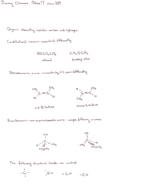
Ether Structures: Ethyl to Dipentyl Varieties Drawn

Want To Learn More? To watch the entire video and ALL of the videos in the series:
full solution
Explore the chemical structures of four distinct ethers: ethyl propyl ether dibutyl ether methyl hexyl ether and dipentyl ether. Understand the role of ether groups which involve an oxygen atom connected to two alkyl or aryl groups.
Want To Learn More? To watch the entire video and ALL of the videos in the series:
full solution
Net ATP Yield from Oleic Acid (18:1 ??) Calculation
Want To Learn More? To watch the entire video and ALL of the videos in the series:
full solution
Join us in this video as we dive into the intricacies of calculating the net ATP yield from oleic acid (18:1 ??). We'll provide a step-by-step guide and offer helpful hints to ensure an accurate calculation, including a critical step that bypasses acyl-CoA dehydrogenase.
Classifying the Boiling of Water: Physical or Chemical Change? Justify
Want To Learn More? To watch the entire video and ALL of the videos in the series:
full solution
This video tackles the classification of boiling water as either a physical or chemical change, examining the provided options. We conclude that boiling is a physical change, as the water's chemical composition remains the same during the transition from liquid to gas.
Lattice Energy: Always Positive; Hydration Energy: Always Negative
Want To Learn More? To watch the entire video and ALL of the videos in the series:
full solution
In this video we clarify why lattice energy in solids is always a positive value due to the energy needed to separate ions making it an endothermic process. On the flip side hydration energy is always negative as it releases heat when ions dissolve in water making it an exothermic reaction. We use sodium chloride as a real-world example to illustrate these crucial thermodynamic concepts
Vaporization vs. Condensation: Heat Absorption & Release
Want To Learn More? To watch the entire video and ALL of the videos in the series:
full solution
Discover the contrasting processes of vaporization and condensation and their thermal nature. Understand why boiling is endothermic, absorbing heat, while condensation is exothermic, releasing heat, and how these processes impact ?H values.