PreparED Study Materials

CHEM 7266: Chemistry Freshman Seminar
School: Truman State University
Number of Notes and Study Guides Available: 1
Notes

Videos

Want To Learn More? To watch the entire video and ALL of the videos in the series:
full solution
Strontium: Deep Dive into Its Isotopes & Atomic Structure
Want To Learn More? To watch the entire video and ALL of the videos in the series:
full solution
Discover the step-by-step process of Barium Sulfate formation from the reaction of Barium Chloride with Sodium Sulfate. Learn about molar mass calculations stoichiometry and yield predictions.
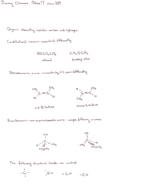
Molecular Geometry & Polarity: Why CO? & CCl? Are Nonpolar Explained
Want To Learn More? To watch the entire video and ALL of the videos in the series:
full solution
Uncover the intriguing relationship between molecular geometry and polarity in chemistry. Using CO? and CCl? as examples, learn how polar bonds can result in nonpolar molecules. Recognize the role of symmetry in determining molecular polarity.
Why is it necessary that protein molecules be enormous?
Want To Learn More? To watch the entire video and ALL of the videos in the series:
full solution
This discussion explores the importance of the size of protein molecules, highlighting their three-dimensional structures, diverse functions, and the role of large size in enabling structural motifs, functional regions, and stability without revealing specific examples or findings.
Moles of H in Samples: H?O, NH?, N?H?, C??H??
Want To Learn More? To watch the entire video and ALL of the videos in the series:
full solution
Discover how to calculate the number of moles of hydrogen in different chemical samples, including H?O, NH?, N?H?, and C??H??.
Understanding Polar & Nonpolar Molecules: From Diazene to Nitrogen Dio
Want To Learn More? To watch the entire video and ALL of the videos in the series:
full solution
Explore the properties of various molecules like diazene, hydrogen peroxide, and carbon tetrafluoride. Understand the influence of molecular shape and electronegativity on polarity. Discover why some are polar while others are nonpolar based on their structure.