PreparED Study Materials

CHEM 211: Chemistry 1 Recitation
School: Kansas State University
Number of Notes and Study Guides Available: 1
Notes

Videos
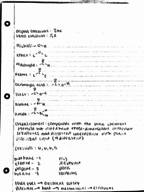
Ether Structures: Ethyl to Dipentyl Varieties Drawn

Want To Learn More? To watch the entire video and ALL of the videos in the series:
full solution
Explore the chemical structures of four distinct ethers: ethyl propyl ether dibutyl ether methyl hexyl ether and dipentyl ether. Understand the role of ether groups which involve an oxygen atom connected to two alkyl or aryl groups.
Precipitation Reactions Explained: From Solution to Solid Formation
Want To Learn More? To watch the entire video and ALL of the videos in the series:
full solution
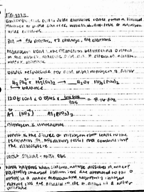
Unravel the chemistry behind precipitation reactions and the creation of insoluble salts. Learn how aqueous ions interact to form solid precipitates, illustrated with examples like silver nitrate and sodium chloride. Understand their significance in fields from water treatment to qualitative analysis.
Identifying Fundamental Units in Rb?O, N?, Fe(NO?)?, and N?F?
Want To Learn More? To watch the entire video and ALL of the videos in the series:
full solution
In this exploration, we delve into the fundamental units of various substances, whether they are single atoms, molecules, or formula units. We examine ionic compounds like Rb?O and Fe(NO?)?, characterized by formula units as their basic components, and covalent compounds like N? and N?F?, where molecules are the fundamental units.
Calculating Ksp for Ca3(PO4)2 at 25°C: Step-by-Step Guide
Want To Learn More? To watch the entire video and ALL of the videos in the series:
full solution
Unravel the concepts of 'Molar Solubility' and 'Solubility Product' to gauge salt solubility. Explore how Calcium Phosphate dissociates in solutions and calculate its unique Ksp value.
Calculating MgO Mass from Oxygen Gas at STP
Want To Learn More? To watch the entire video and ALL of the videos in the series:
full solution
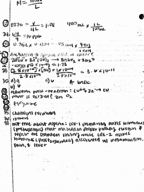
In this video, the problem involves calculating the mass of magnesium oxide (MgO) produced when 14.8 liters of oxygen gas react with magnesium metal according to the chemical equation 2Mg + O2 -> 2MgO. The stoichiometric relationship is used to determine that 0.6607 moles of oxygen gas results in 1.3214 moles of MgO, with a final calculation yielding a mass of 53.25 grams of MgO formed during the reaction at Standard Temperature and Pressure (STP).
Determining Base Concentration Using KHP: Indicator Choice Solution
Want To Learn More? To watch the entire video and ALL of the videos in the series:
full solution
Discover how to choose the right indicator for a titration involving Potassium hydrogen phthalate (KHP) and a strong base. Grasp the calculations from molar mass to pH and understand why Thymolphthalein is the ideal choice for a change near pH 8.95.