PreparED Study Materials

CHEM 122: Foundations of CHEM I Lab
School: Old Dominion University
Number of Notes and Study Guides Available: 3
Notes


Videos
Mastering Mass, Moles, Formula Units & Atoms

Want To Learn More? To watch the entire video and ALL of the videos in the series:
full solution
Discover how to precisely calculate mass, moles, formula units, and atoms in various compounds. Understand the concept with examples like chromium(III) sulfate decahydrate, dichlorine heptoxide, and lithium sulfate. Master chemistry calculations through a step-by-step guide.
Determining Formula Mass: Step-by-Step Approach Using Atomic Masses
Want To Learn More? To watch the entire video and ALL of the videos in the series:
full solution
Discover the method to determine the formula mass for various compounds. Learn about the importance of atomic masses and their role in compounds like Aluminium sulfate, Diphosphorus Trioxide, and more. Understand the step-by-step approach to accurately calculate molecular weights.
Mastering Ionic and Net Ionic Equations for Varied Chemical Reactions
Want To Learn More? To watch the entire video and ALL of the videos in the series:
full solution
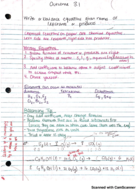
Discover the art of writing balanced, complete ionic, and net ionic equations for various chemical reactions. Learn the nuances that differentiate between these equations and watch them applied to diverse chemical reactants.
CO?: Linear & Nonpolar with Temp Dipole Moments Explained!
Want To Learn More? To watch the entire video and ALL of the videos in the series:
full solution
Uncover the nuances of the CO? molecule's polarity and its electron dynamics. Understand how bending and stretching motions influence its electron density. Grasp the analogy of CO? to a jumping rope, highlighting its overall nonpolar nature.
Determining Ionizable H Atoms in Malonic Acid via Neutralization
Want To Learn More? To watch the entire video and ALL of the videos in the series:
full solution
Explore the process of determining ionizable hydrogen atoms in malonic acid using its molecular formula C3H4O4 and a neutralization reaction with Sodium hydroxide. Through methodical calculations involving the given mass of malonic acid and the required volume of Sodium hydroxide for neutralization we uncover that each molecule of malonic acid contains two ionizable H atoms.
Determining Bond Types: Ionic, Polar Covalent, or Covalent in Chemical
Want To Learn More? To watch the entire video and ALL of the videos in the series:
full solution
This discussion revolves around the classification of chemical bonds as ionic, polar covalent, or covalent based on the electronegativity difference between the atoms involved. The general criteria for this classification are explained: a difference greater than 1.7 indicates an ionic bond, between 0.5 and 1.7 signifies a polar covalent bond, and less than 0.5 designates a covalent bond. It then applies these criteria to four specific examples, including the CC bond in ethane (H?CCH?), the KI bo